




(Ler artigo em português aqui)
Diamonds are forever and a girl’s best friend, according to Marilyn Monroe. Her centenary is being celebrated in 2026, the same year Bowers & Wilkins unveiled the new 801 D5 in Vienna. The coincidence couldn’t be more fitting.
In 1999, I toured the B&W Research Centre in Steyning, where I met John Dibb and Peter Fryers, and through them I met the first B&W Nautilus 801s. At the time, however, no one mentioned diamonds yet.
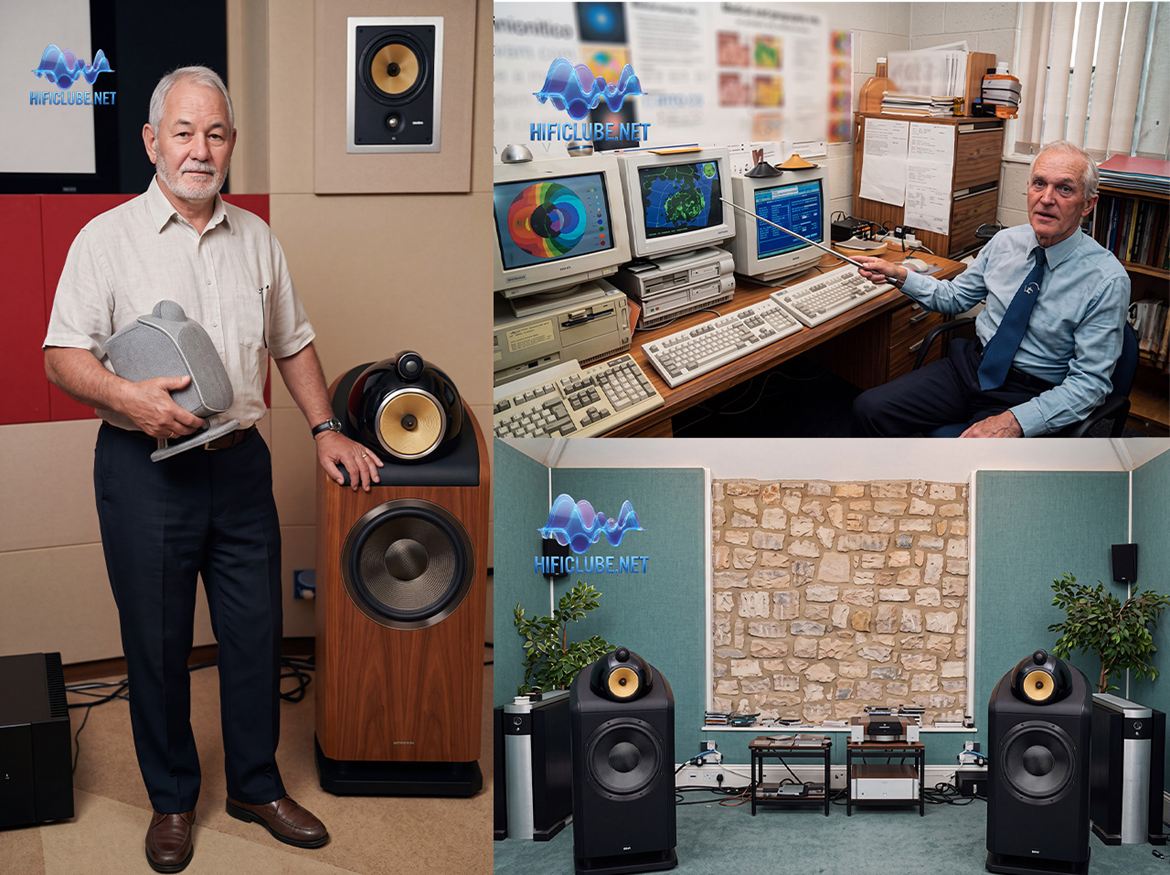
Prof. John Dibb (left), John Fryers (top right), and the first B&W Nautilus 801 with Marlan head and front port.
Note: To read the article entitled ‘In Utero', open the three PDF files at the end of this article.
In 2004, I was in London for the world premiere of the first 800 Series Diamond, along with a delegation of about 150 professionals and journalists from around the world. I was at that event when the diamond became an inseparable part of the 800 Series' history, and I subsequently wrote an article for Hificlube titled "Diamonds Are Forever".

The legendary B&W Nautilus
I had the chance to hear the 801 D5s in Vienna during a private listening session, also attended by Laurence Dickie, the original designer of the remarkable Nautilus—the speaker that established many of the acoustic and mechanical principles that still form the DNA of the 800 Series.
Dickie didn't hide his enthusiasm, as the video below shows. I didn't either. Since I started keeping an eye on this development in 2004, I also agree that improvements in sound quality from one generation to the next haven’t always kept up with the huge technological investment—and the inevitable 'marketing hype' that went along with it.

Laurence Dickie (Viena 2026)
Laurence Dickie
It's probably no accident that Laurence Dickie, who is now with Vivid Audio—the same man who, more than thirty years ago, designed the Nautilus without giving any thought to whether it could actually be manufactured, let alone sold—was present in the room and heard the 801 D5s with a smile of approval. And who is better qualified to give the D5 the seal of approval?
I can now say that all that technology has at last led to more and better music. It hasn’t always been the case.
Evolution or Revolution?
No doubt, each of the D2, D3, and D4 generations has always been technically superior to the one that preceded it. And some of the modifications were genuinely revolutionary: the Continuum, the Aerofoil, the Turbine Head, the Reverse Wrap, the Biomimetic suspension, and the successive evolutions of the Matrix.
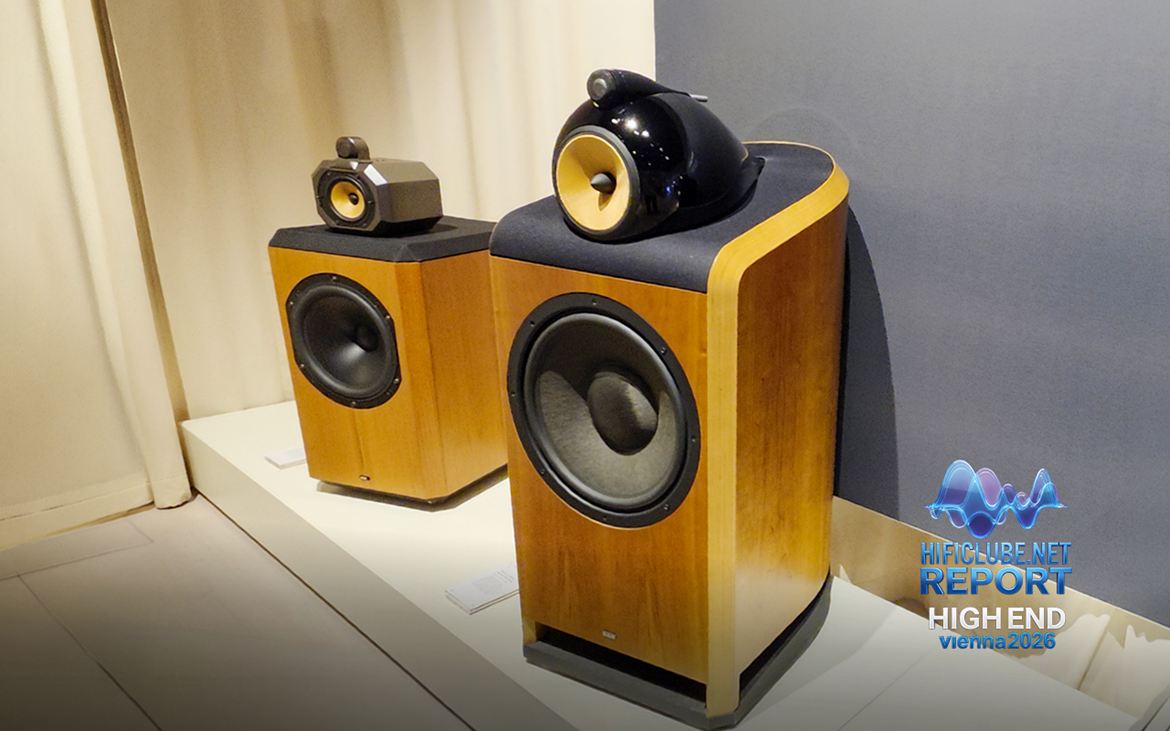
B&W 801 (1979) and B&W Nautilus 801 (1998)
The 801 Saga
The origins of the 801 go back well before the diamond driver was introduced. In 1979, following four years of research, John Bowers, whom I had the pleasure of meeting, launched the first 801 by combining the principles that had already been used in the DM6—namely time alignment, a dedicated midrange driver, and Kevlar—with the top-mounted tweeter that was first seen in the DM7.
An architectural design therefore emerged which, forty-seven years later, is still identifiable in the present-day 801 D5. The diamond driver did not appear until twenty-five years later.
1987 - The Matrix 801 underwent its first major change, switching from a sealed enclosure to a bass-reflex design with a front-firing port and introducing Matrix bracing, which would later become one of the company's signature technologies.
1998 - The Nautilus 801 was introduced. The Nautilus 800 Series brought about major changes to the cabinet's shape and the speakers' dimensions; the 801 was upgraded from a 12-inch woofer to a 15-inch woofer and from a 5-inch midrange to a 6-inch midrange mounted on a Marlan head (a synthetic material composed of mineral and resin).
2004 — The Diamond Is Born.
On November 17, 2004, the original series was launched at the same time in both London and New York, representing the first major revision of the 800 series in more than six years; the highlight of the series was a tweeter fitted with a polycrystalline diamond dome manufactured by chemical vapour deposition, a component that did not break up until frequencies exceeded 70 kHz.
The sandwich cones now used an 8mm Rohacell core between layers of carbon fibre; the midrange remained a Kevlar FST design but gained a new neodymium motor and an improved chassis.
The 800D, which had two 25-cm woofers, weighed a respectable 125 kg and included the spherical Marlan dome, the Matrix, the Flowport, and the Nautilus-inspired tubular tweeter. Even the crossover capacitors used silver and gold.
On paper, it was flawless. The Diamond series did provide greater extension, transparency, and resolution. Yet it also reinforced a trait that would appear in several later generations: that little sparkle in the eyes that could make some recordings shine with too much intensity. The engineering was more impressive than the music.
D2 — Refining Without Changing the Formula
The D2 generation, as we now call it retrospectively, appeared in 2010, though it was still officially the 800 Series Diamond. Diamond technology was introduced throughout the whole range, including the 805.
The tweeter was fitted with a more efficient four-magnet motor; the woofers were given a dual-neodymium magnetic system in order to reduce distortion and improve linearity; new oxygen-free copper terminals were introduced, and the Mundorf silver/gold/oil capacitors—which had earlier been reserved for the 800D—were now used across the entire range.
The 800 Diamond introduced a bass cone with a "mushroom" structure that incorporated the cone, voice coil, and dust cap into a stiffer unit, along with a new motor to improve control and dynamics.
The bass got cleaner and the midrange more balanced, although there was still a slight increase in presence and a plateau ranging from about 7 to 15 kHz. B&W stayed true to itself, whether that was a good thing or not.
D3 — 868 Ways to Start a Revolution
In 2015, Bowers & Wilkins went from evolution to revolution, announcing no fewer than 868 changes!
At the time, I said this might, ironically, make a D2 owner believe they had bought a speaker with 868 defects. Of course, they hadn't, but this time the structural changes run very deep.
After decades of use, the yellow Kevlar was discontinued, and Continuum was developed over eight years; the Rohacell woofers were replaced with Aerofoil cones, which vary in thickness.
In models with a separate midrange driver, the Marlan design was replaced by a turbine head, manufactured from aluminium; the tweeter body was likewise machined from a solid block of aluminium.
In the 800, 802 and 803 D3, B&W effectively turned the cabinet inside out with Reverse Wrap, moving the curve to the front and the cabinet joint to the rear, where a large aluminium spine added rigidity and acted as a heatsink for the crossover. This represented the greatest technological advance in the long history of the Diamond series.
At that time, I noticed genuine improvements: less colouration, better microdynamics, greater soundstage stability, and a more natural decay. Yet I also recall that the midrange and treble integration of the 805 D3 and 804 D3 was better than that of the larger 802 D3.
It was an outstanding engineering achievement, but I don't remember now whether the greater enjoyment I got from the music was directly proportional to the 868 part changes…
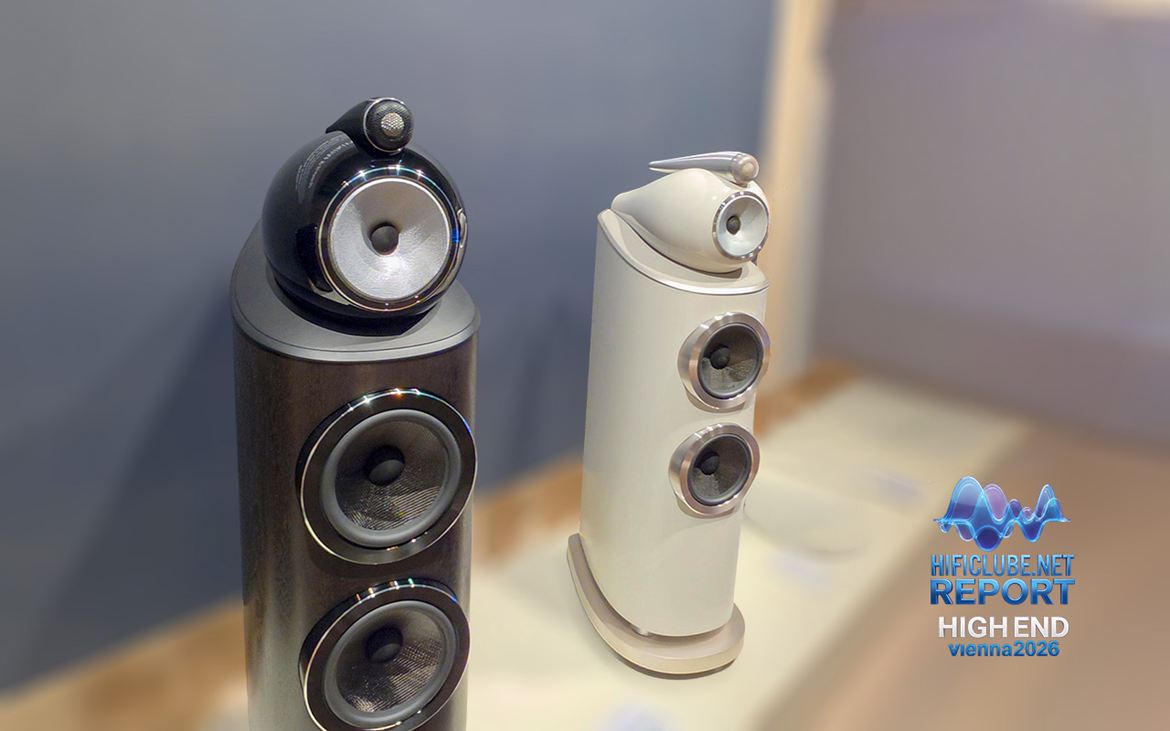
B&W Nautilus 801 D4 and D5
D4 — Tackling Everything that Vibrates
The D4 was launched in 2021, and B&W then brought back the historic 801 name for its top model.
Reverse Wrap was extended across the entire range; the Matrix gained additional metal reinforcement; an aluminium top plate was introduced; and the tweeter’s tubular body became much longer, reaching almost 30cm.
Maybe the most intelligent innovation was the Biomimetic Suspension used with the Continuum midrange driver: it replaced the conventional fabric spider in the midrange cone with a much more open plastic structure, thereby reducing air pressure and parasitic energy losses in the cone.
It wasn't just theoretical; measurements published by Hi-Fi News indicated a reduction in distortion of about 6 to 8 dB compared with the 800 D3 and a clear decrease in spurious components in the 5 to 9 kHz range.
The D4 models were cleaner, more controlled, and more transparent; yet even the 801 D4 still showed some excess energy in laboratory tests, in the 6-10 kHz range—perhaps due to the diamonds' sparkle.
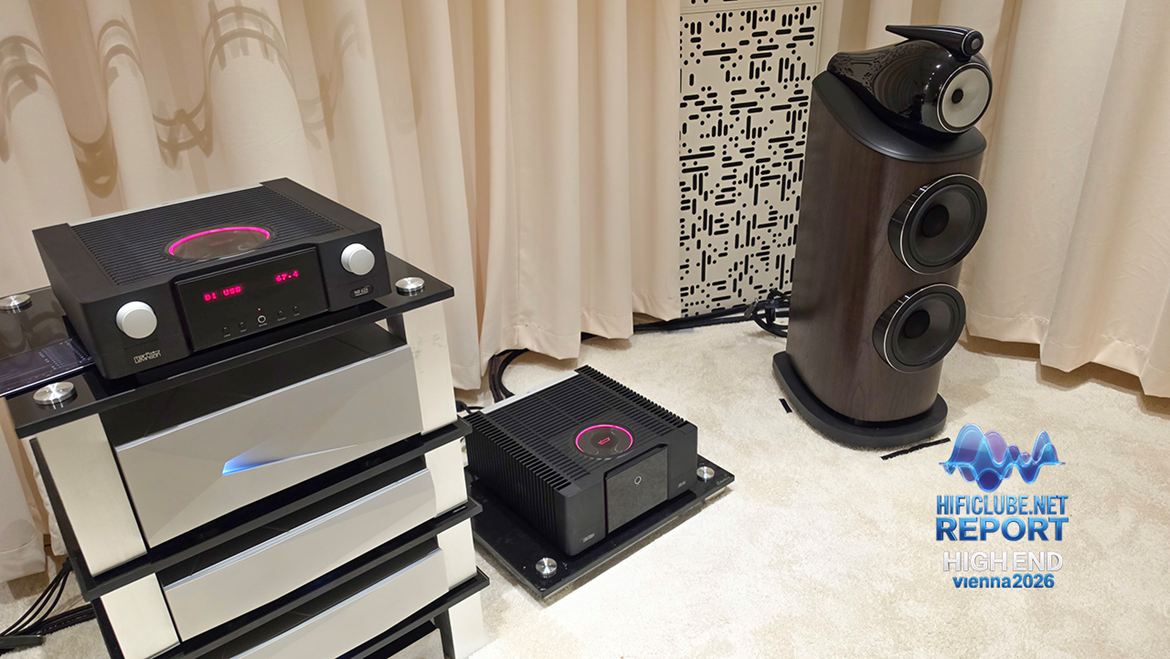
B&W Nautilus 801 D5 demonstration setup with Mark Levinson Electronics
D5 — Give Me Five, B&W!
Thus, we find ourselves in Vienna in June 2026.
At first sight, the 801 D5 could be mistaken for a D4. B&W didn't come up with a brand-new miracle material for the cone, nor did it substitute diamond with some other space-age material, let alone initiate another aesthetic revolution. Instead, it focused on the details.
The new Space Frame Bracing adds aluminium rails and crossbars to the rear of the Matrix. At the front, Enhanced Matrix uses thick, profiled aluminium sections around each drive-unit aperture to increase stiffness. The top plate is now thicker, stiffer, and has better damping. The new pedestal incorporates both constrained-layer and tuned-mass damping, with the masses being specifically calculated for each model.
The lessons drawn from the D4 Signature included a more transparent tweeter grille, drivers with reduced midrange and bass distortion, better crossover components, new internal wiring, improved terminal connections, and an all-aluminium plate to support the crossover and reinforce the structure.
This is the great paradox concerning the D5: the main specifications of the 801 have remained almost unchanged.
The 25mm Diamond Dome tweeter, 150mm Continuum FST midrange driver and twin 250mm Aerofoil bass drivers are retained; the sensitivity is 90 dB, the impedance is 8 ohms with a minimum of 3 ohms, the frequency response is 15 Hz to 28 kHz plus or minus 3 dB, and the recommended amplifier power is 50–1,000W into 8Ω on unclipped programme. The D5 now weighs 106.4 kg, up from the D4's 100.6 kg.
That is to say, the figures tell pretty much the same story, but you'll notice a great deal of improvement.
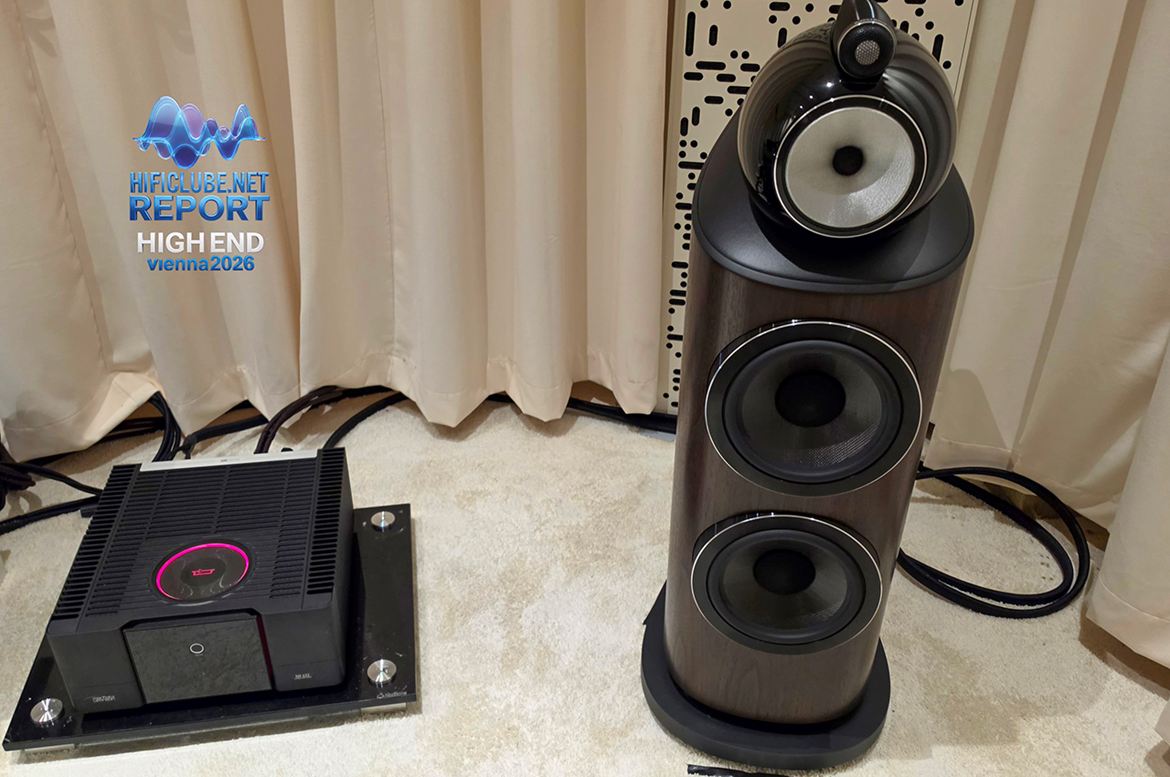
Viena, 2026: Mark Levinson No.632 mono amplifer and B&W Nautilus 801 D5
Vienna At Last!
In the demo room, the 801 D5s were connected to the new Mark Levinson amplifiers, together with a No. 626 preamp and two No. 632s amplifiers, plus the monumental Innuos Nazaré server/streamer as the source.
This was most likely the best pair of Bowers & Wilkins 800 Series loudspeakers I have ever heard.
Microscopic clarity is still present, as is the strong bass, which reaches into the lowest frequencies without having to ask a subwoofer for permission, and that B&W ability to project sound is still there too. But the tendency to constantly show off—by saying “Look how good I am!”—is gone...
The midrange sounds smoother, with more body and texture. The treble stays open and is extremely informative, though it is better integrated and less likely to draw the ear's attention. The bass has attack, definition, and, most importantly, pace and rhythm: it is not just deep; it starts and stops on a dime. I am sure I wasn't the only one to notice this change.
As I said before, Laurence Dickie was with me, and he also noticed the greater coherence, smoothness, and naturalness, along with less grain and less aggressiveness at the top end.
The presentation included 4 or 5 tracks covering various musical genres, but the only piece I managed to record was ‘Hit or Miss’ by Odetta. I'm sure you'll understand what I mean, even though I recorded the sound on a mobile phone.
Technology in the Service of Music
There is a lesson in this lengthy saga.
From 2004 up to and including the D4 model, Bowers & Wilkins has provided technologically brilliant solutions; yet greater technology did not always result in better music.
With the generation D5, the 801 now appears to have reached maturity, since it no longer tries to make an impact with new cones made from new extraterrestrial materials; instead, it removes minor sources of noise, distortion, vibration, and stored energy, so the cabinet interferes less with the drivers.
I find it amusing that B&W, by introducing less revolutionary technology, has produced the most musically convincing 801 generation.
I can’t say diamonds last forever, but at last they no longer outshine the music. Give me five, B&W!
Important notice: Hificlube.net will be visiting the B&W factory on September 28, 2026. Stay tuned for the full report.
For further information: