


Azzolina Quark - Brief Intro on Video by JVH
Azzolina Audio is a boutique brand specializing in niche audiophile products made in Portugal, including horn speakers and single-ended triode amplifiers. It recently launched the Quark monitor, which aims to stir up the market and already has strong support from Imacústica, with exclusive distribution rights in Portugal.
I first heard the Quarks informally at Imacústica–Lisbon, in the showroom, powered by a Jadis i300. Nonetheless, I immediately realized I was hearing something special. I took a pair home for a closer look and found that the Azzolina Quarks are much more than meets the eye.
Charles Edward Azzolina-Michlin
Therefore, I have committed myself to unraveling the mysteries of a seemingly ‘elemental' speaker, much like the particle that bears its name. As I progressed through the test, I realized that the Quark is not merely another compact monitor; it is a true master's thesis in electroacoustics, developed over 25 years by Charles Edward Azzolina-Michlin, an American raised in Texas. He grew up in a musical family, was trained as a pilot, and later worked as a helicopter instructor while developing a passion for horn speakers and SET triode amplifiers.
Quark is not merely another compact monitor; it is a true master's thesis in electroacoustics.
What began as a hobby developed into a small business, operated alongside his aeronautical career. In 2016, the family relocated to France. In 2021, they moved to Portugal, where Charles Azzolina now resides and works among the vineyards of Amarante with his wife Camila, a Brazilian designer and architect, and Joabe, a CNC and carpentry expert.
At first glance, the Quark—€5,000 per pair—is a compact elliptical monitor, in the Sonus Faber tradition, with natural birchwood side panels and a top, base, and baffle made of rigid synthetic resin reinforced with long wood fibers. It features a single full-range driver and a flared wide-mouth front bass reflex with an unusually short duct length.
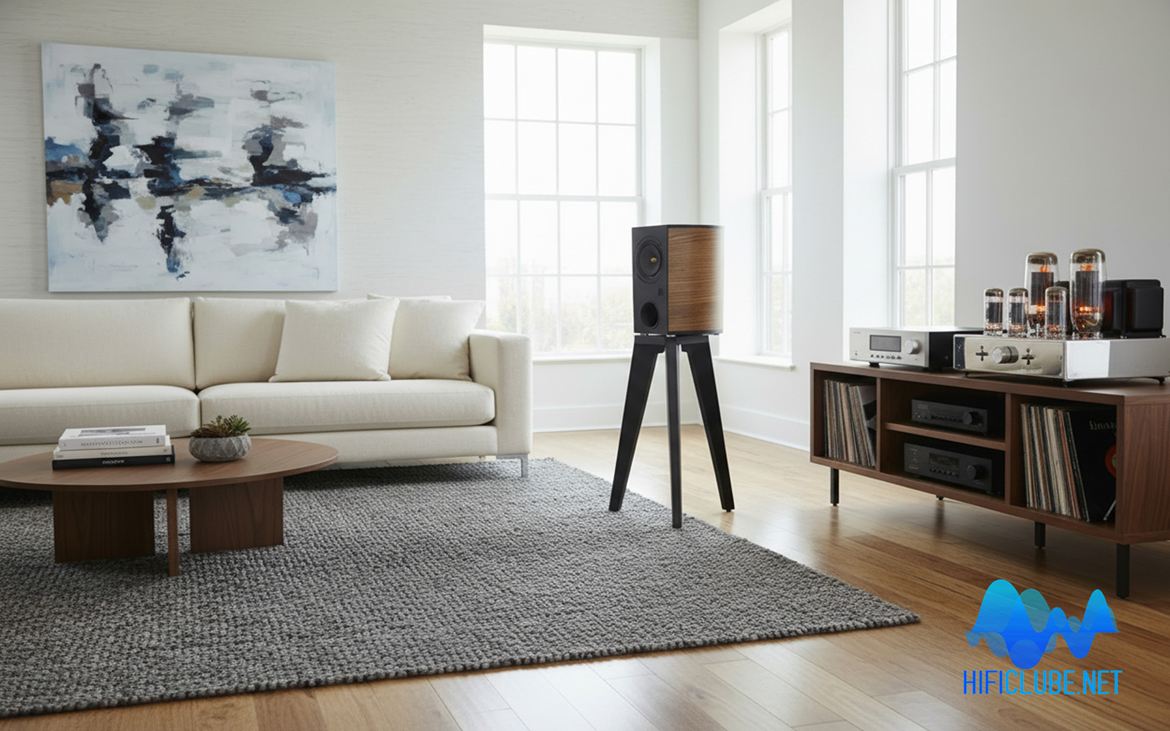
Quark lifestyle photo by JVH/Photoshop
Made in Portugal
My first surprise was to discover that the Azzolina Quark, despite its unusual name, is proudly produced in Portugal. The second was to realize that Charles Azzolina spared no effort to create a small monitor with some virtues of large horns—speed, dynamics, and sensitivity—but without the drawbacks of size, cost, and low WAF.
The Quarks have a sensitivity of 92 dB (1 W/1 m) and a stable nominal impedance of 8 ohms, making them ideal for low-power SET amplifiers (8/10 W). Like good horns, they offer that distinctive sensation of hearing sound 'directly from the source.'
Pure, Unfiltered Music
The Quark boasts a single full-range driver. It's similar to a Tang Band W-5 1611 SAF, an underhung design, with a 5-inch treated-paper cone, an inverted butylene suspension, and a copper-coated aluminum phase plug to increase dispersion.
Note: According to Charles Azzolina, the driver is custom-made to specification in Germany with a substantial copper sleeve and thick short ring to reduce coil inductance and high-frequency harmonic distortion.
And the driver works with no crossover at all. Not even a BSC network!
And that's when I started being intrigued.
Charles Azzolina refuses to compromise his pursuit of pure, unfiltered sound, keeping the signal as direct as possible without crossover or BSC network.
Narrow deflectors (Quark's is only 18 cm) are prone to diffraction-induced output losses of -3 to -6 dB centered around 675 Hz and up to 2 kHz, which can make the mid-high response sound brighter by comparison. This issue is typically corrected with a BSC network (Baffle Step Compensation): a non-inductive resistor (2.7 ohms) and an air inductor (0.68 mH) in parallel, mounted in series with the driver.
Charles Azzolina refused to compromise his pursuit of pure, unfiltered sound, keeping the signal as direct as possible without crossover or BSC network. Filters tamper with sensitivity and dynamics—hence also the immediacy of the sound—and impedance, which would make the Quarks more challenging to drive with the recommended SET amplifiers.
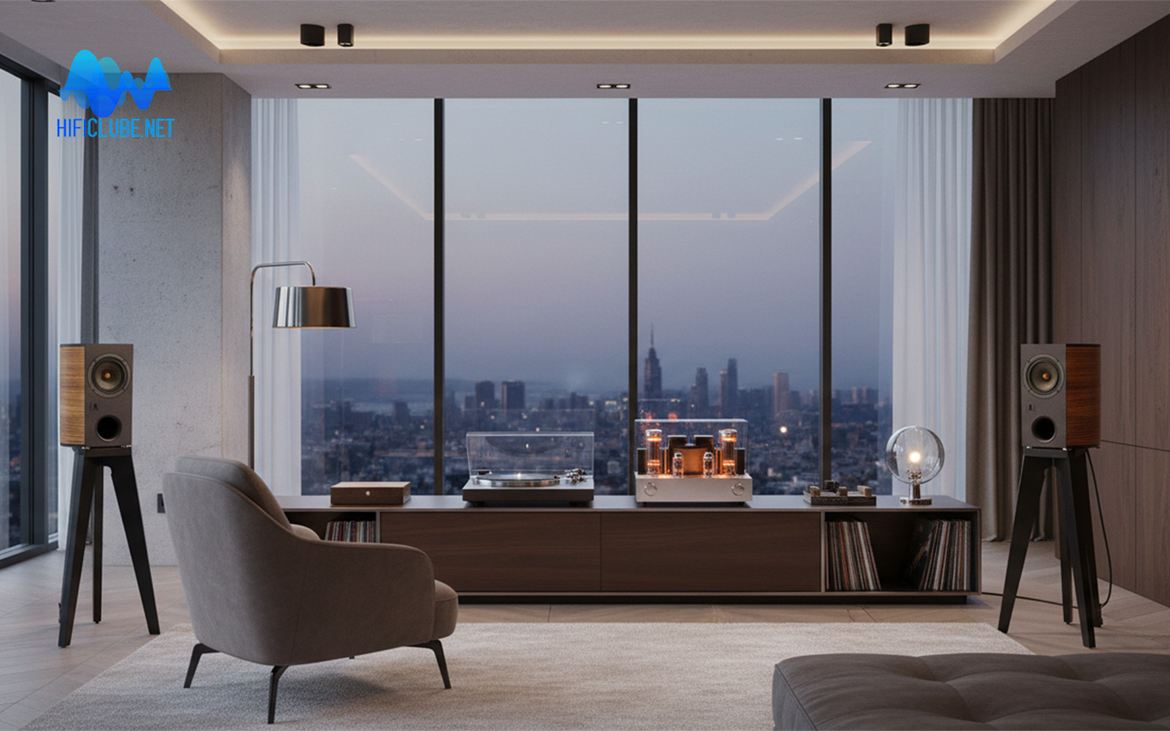
Lifestyle photo /New York (Photo by JVH/Photoshop)
Bullock Vintage Tuning
Charles Azzolina also recognises that bass reflex loading is a necessary evil; it enhances the bass but can introduce colourations and affect the impulse response, to which he admitted being very sensitive. However, with such a small single driver, there was no alternative if the goal was to achieve the specified 35–21,000 Hz response. Nonetheless, he managed to keep the bass tightly controlled by employing a Bullock Vintage alignment with a large-diameter reflex front port, featuring a flanged wide mouth and a short, tapered duct.
With external measurements of 18 × 30 × 37 cm and assuming 12 mm-thick panels, the internal volume is approximately 11 liters. Therefore, applying Helmholtz’s formula to a simple straight port 10 cm in diameter and 7 cm long would suggest an unusually high tuning frequency (around 67 Hz).
However, the Quark uses a flared wide-mouth front port and a short, tapered duct, so the effective acoustic length is longer than the physical duct length: the flare increases end correction (adding a significant “virtual” length), while the tapered geometry and the acoustic mass/resistance added by the perforated partition “filter” can further shift the result. In practice, this can bring the tuning down into the 45 Hz region. The room will handle the rest, depending on the distance to the front wall.
Note: This still qualifies as close to a BB4 alignment (Butterworth 4th order), as certified by Charles Azzolina, which provides fast, dry, and articulate bass with low port turbulence.
Quarks can be tentatively positioned near the front wall to enhance bass. Start at 25 cm from the wall and move them back in increments of 3–5 mm: first with pink noise, then play some music with bass content.
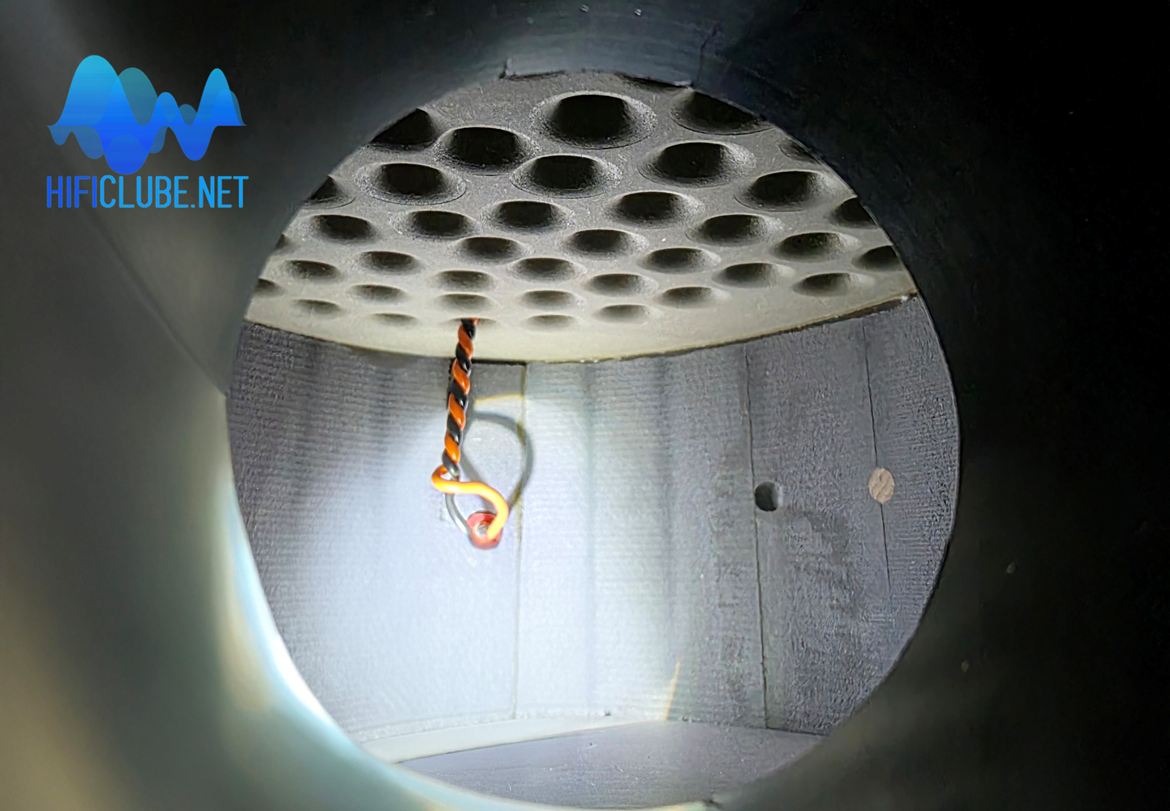
Interior of the reflex system's chamber. At the top, the perforated filter that divides the speaker chamber from the reflex port chamber. Photo by JVH.
Secret Acoustic Filter
Charles Azzolina also mentions an unspecified ‘patent-pending' acoustic filter. The filter, which you can see by peering through the port (see photo above), separates the lower chamber of the reflex tube from the upper chamber of the driver and controls the standing waves at the same wavelength as the duct resonance frequency (around 1.28 kHz). This reduces the ‘organ pipe’ effect.
I believe it operates on a similar principle to MPP (micro-perforated panels), which absorb specific frequencies and act as a resistive-reactive filter. In practice, it functions as another Helmholtz resonator. The target frequency can be adjusted by changing the hole diameter to control the reflex port's resonance frequency, which differs from the tuning frequency.
This 'pipe' effect would otherwise be audible, particularly since Azzolina refuses to fill the cabinet with foam or other absorbing 'sound muffling' materials, as is common in most loudspeaker designs.
Note: The “organ pipe” effect in reflex systems occurs due to mid-frequency longitudinal standing waves within the cabinet that excite the air inside the duct at its resonance frequency.
Important note: In early Quark prototypes, the internal walls were sculpted with facets arranged in decreasing proportions to eliminate periodicity and disperse internal modes (see video above). However, during a long conversation on Zoom, Charles Azzolina told me that he had concluded that the benefits of this irregular (almost anechoic) pattern did not outweigh the disadvantages of reduced cabinet structural rigidity and lower effective internal volume. So, he abandoned this technical option in the current production models. But I'll show you the video anyway, because I think it is spectacular.
This prompts the question: how does Azzolina control the cabinet's internal standing waves now?
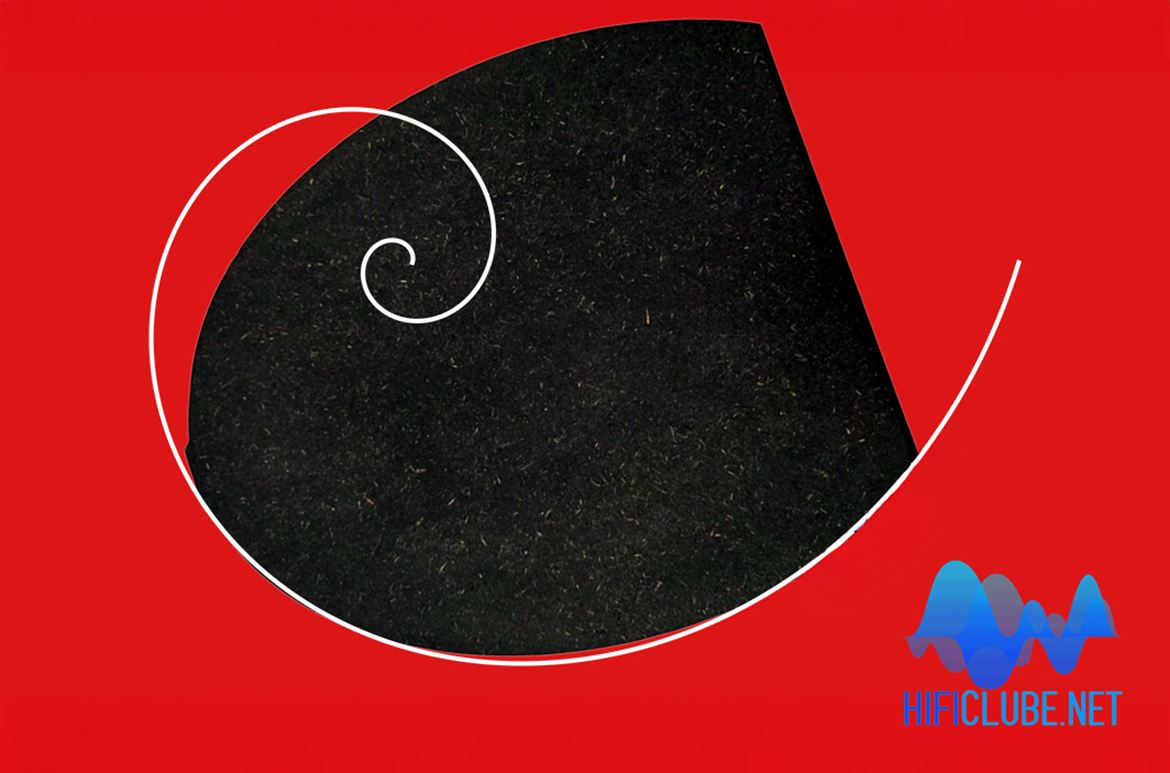
Fibonacci Spiral superimposed on the Quark's top plate for reference. Notice the slight deviation in the lower section.
Divine Dimensions
The elliptical shape itself is also a vital part of the solution: curved surfaces are stiffer and less resonant, and the absence of parallel walls reduces internal reflections.
Charles Azzolina claims that the cabinet was constructed according to the ‘Golden Ratio’. However, as shown in the photo below, the white spiral is a true golden spiral (logarithmic, growing by φ ≈ 1.618 each quarter turn), but it is not perfectly aligned with the edge of the Quark's elliptical top plate. Note: I acknowledge that there may be some parallax error due to the camera lens.
However, in linear terms, the ratio of the dimensions is 30 cm / 18 cm = 1.667, which is very close to 1.618, with a—probably intentional—variation of about 3%. This results in a slightly rounded elliptical cabinet, most likely with even better acoustic properties, as it proved more effective at reducing diffraction than a precise mathematical golden spiral.
Whatever the reason, congratulations to the designer are certainly in order, as both visually and acoustically, the results are awe-inspiring indeed.
The Price of Magic
Regarding cone dispersion, the laws of acoustic physics are unavoidable: above 2 kHz, a 5-inch cone becomes directional, and the dispersion angle narrows, making the sound more incisive—particularly when there is no tweeter to assume its role.
The phase plug reduces this effect, improving dispersion up to around 5 kHz—quite effectively, in fact—but it cannot work miracles much beyond that. Probably, that's why I prefer not to toe-in too much. They sound best when aimed directly into the room and listened to off-axis at 30º. And, in my experience, they also perform optimally in near-field listening, as if you were in a mixing studio.
Note: Alternatively, you can angle them sharply towards a virtual point in front of the listener. This still counts as off-axis listening but improves focus.
During our extended Zoom meeting, Charles Azzolina stressed that the driver's polar response displays a well-behaved dispersion even at high frequencies. However, I think he still relies on the acoustic properties of SET amplifiers to make the Quarks perform at their best.
Perfect Match
Quarks are designed to deliver optimal sound when driven by low-powered 8–10 W SET/300B amplifiers, which are a perfect match in terms of acoustic and electrical properties.
- The 92 dB sensitivity does not require high power.
- The Bullock alignment compensates for the naturally round and somewhat slow bass typical of the 300B, for example.
- The euphonic, laid-back presence zone—another well-known characteristic of the 300B—is balanced by the Quark's slightly elevated plateau between 2 and 5 kHz, due to the transducer's narrowing beam at high frequencies.
- The high output impedance of SETs causes a gentle attenuation above 12 kHz, effectively taming the upper treble of the Quarks.
- The copper ring and sleeve on the motor pole reduce 2nd- and 3rd-order harmonic distortion, which SET amplifiers tend to emphasize, and audiophiles love.
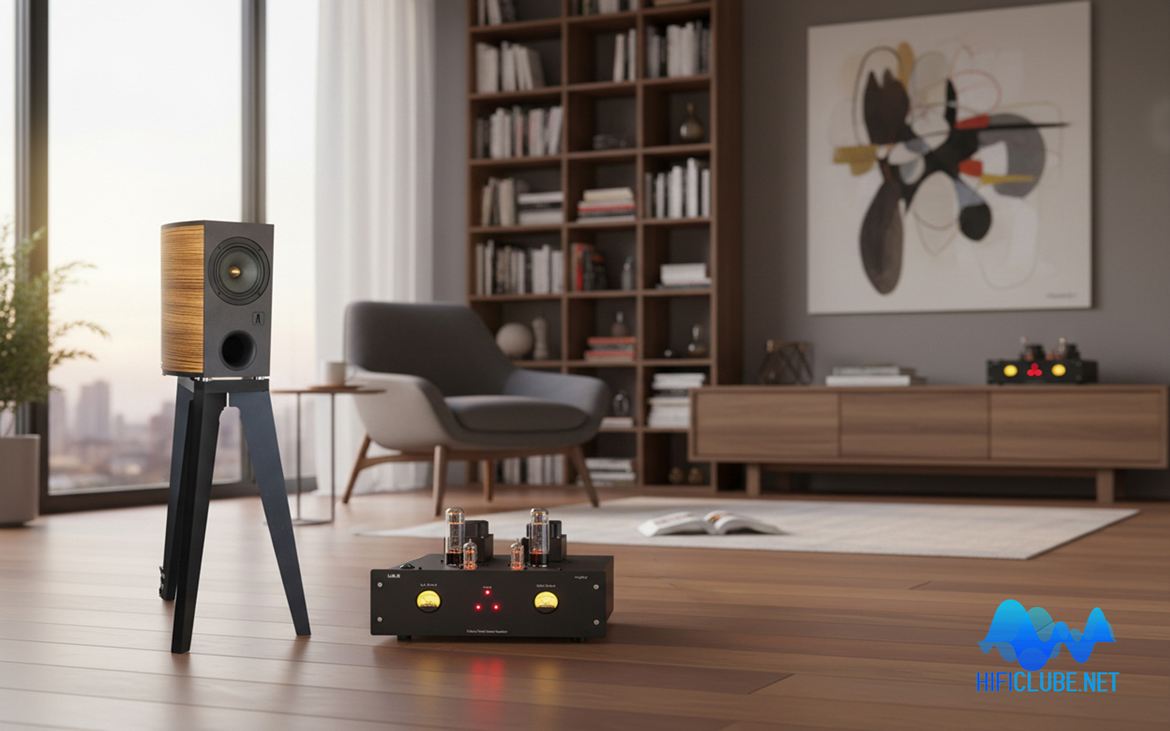
The Quark and the Lab 12 Mighty (Photo by JVH/Photoshop)
Quark + LAB12 Mighty
Transistor amplifiers can also drive the Quarks, but the tonal quality will differ—and not for the better. The low output impedance and high damping factor of most solid-state amplifiers contribute to drying up the sound of non-crossover speakers like the Quarks.
Finally, avoid Class D if possible *. Be ready to take home a SET amplifier, such as the Jadis 300 B. If you already own one, pair it with the Quarks because you ain’t heard nothing yet.
*Note: I confess I drove the Quarks with a very affordable Eversolo Play (Class D) and the sound was a little dry but quite decent nevertheless.
I don't have a Jadis 300B—which contradicts all my rhetoric—but I have the next best thing: an 8 W (2 × EL34) LAB12 Mighty running in triode mode. And they also pair very well with the Quarks.
I admit I used a light parametric EQ in Roon, but I won't disclose the settings: they vary with the room, amplification, and personal taste. Before tweaking the EQ, try different positions. Or better yet, forget about EQ entirely and listen to the Quarks “au naturel”. With tubes, of course! What else?
Note: Taking EQ lovers to the limit, Charles joked about audiophiles who install new component devices and software in their Class D amplifiers to emulate tube distortion. I wrote about something similar here.
The Sound of Quark
Fernando Pessoa's well-known slogan, ‘First it sounds strange, then it grows on you,’ might seem a bit clichéd today. Nevertheless, it genuinely captures what one experiences when listening to a speaker with no crossover and no foam to absorb internal standing waves. It may initially sound ‘hollow’, but eventually you will realize it's the other speakers that sound muffled. What is most remarkable, however, is the response speed.
With a single driver managing all the music, everything sounds coherent like a unified whole—even when you sit off-axis and relatively close, like in a recording studio.
The bass is genuine: it's neither too deep nor overblown; rather, it's light-footed and unexpectedly precise;
The mids may lack the density and weight of larger monitors. But voices, both male and female, sound natural, remaining clear and free of any boxy colorations or muddiness;
The highs offer a breath of fresh mountain air with a touch of morning light, which tubes filter like Polaroid glasses.
Above all, the pace and time are superb, and the handling of transients is nearly addictive. They are not built for home cinema fireworks; they are intended for those who value texture, detail, and that feeling of ‘musical truth’. It also helps that the cabinet disappears rather than singing with its mouth full of foam.
If you admire the romantic charm of SET amplifiers but face limitations due to space, budget, or a tolerant wife when it comes to fitting horn speakers in your living room, the Quarks seem perfectly suited to you.
The highs offer a breath of fresh mountain air with a touch of morning light, which tubes filter like Polaroid glasses.
Living With Quark
Given the low WAF (Wife Acceptance Factor) of horn speakers, the Quarks are ideal for any audiophile's wife: small, attractive, and elegant, mounted on high-heeled tripods, and not requiring placement in the middle of the room. However, corners should still be avoided, as well as potted plants on top of the Quarks…
Listen to the Azzolina Quark at Imacústica with a Jadis 300B—or any good quality SET amp—and be warned: you'll not just be impressed, you'll be hooked! I was.
Note: Written in US English to honor the designer.
For further details, please contact: