



Imagine a young student living in a small room who manages to save €1,500 with help from their family, thanks to birthday and Christmas gifts and good grades rewarded by doting parents. Most of them will spend it on a new phone or a holiday with their girlfriend and friends if they are already independent. A minority will buy a stereo system.
A pair of earbuds, and job done!
To enjoy your favourite tunes, all you need is a pair of headphones—those you stick in your ears—connected to your phone via cable or Bluetooth to Spotify. You can even share them with your girlfriend: each listens to one channel, and you're all set! Young people aren’t concerned with sound quality. In fact, neither are the engineers who mix modern music: all that matters is that it sounds louder on the radio than the competition. They call it 'The Loudness Wars’
The return of the old ‘hi-fi stack’
But many still yearn to buy a ‘stereo’ or sound system, just like I did in my youth. Perhaps influenced by their parents, they occasionally read my work as well as other national and international audio writers, so they already understand concepts like stereo imaging and soundstage. They hold onto the hope of fulfilling their student dream with an old-school setup comprising a source, an integrated amplifier, and speakers. Nothing complex or costly: pouring a fortune into a sound system is something only the wealthy can afford.

The AE300-2 fit well in a student's den.
Vinyl is cool
The CD has fallen out of favour and been replaced by streaming. The more ‘sophisticated’ prefer the LP, which is ‘cool’ again. But LPs are expensive, and parents safeguard their precious vinyl collections like the crown jewels. As space is limited, they opt for an all-in-one device: streamer/DAC/amplifier. Not long ago, I tested one that meets all these requirements: the Eversolo Play. We'll get to that in a moment.
Globalisation and inflation
Now only the speakers are missing. Here, the options are broader than those for the candidates for the Presidency of the Republic, and they all pledge to obey and uphold the audiophile constitution. Which they all do – in theory.
There is something for all tastes, sizes, and prices. Most of them are made in China for cost and profit reasons. I still remember visiting speaker factories in the United Kingdom. Nowadays, nobody invites me anymore: they post videos on YouTube and send the speakers via DHL. These are the effects of globalisation and inflation. Speakers like the AE300 MkII, made in Europe, would now cost nearly €2,000.
Music in Mandarin
But don't worry, they don't only sing in Mandarin. They sing in English, the world’s universal language — and they sing well. This is true for these Acoustic Energy speakers, which, costing €800, face stiff competition from B&W, DALI, Wharfedale, etc., all European brands manufactured in China.
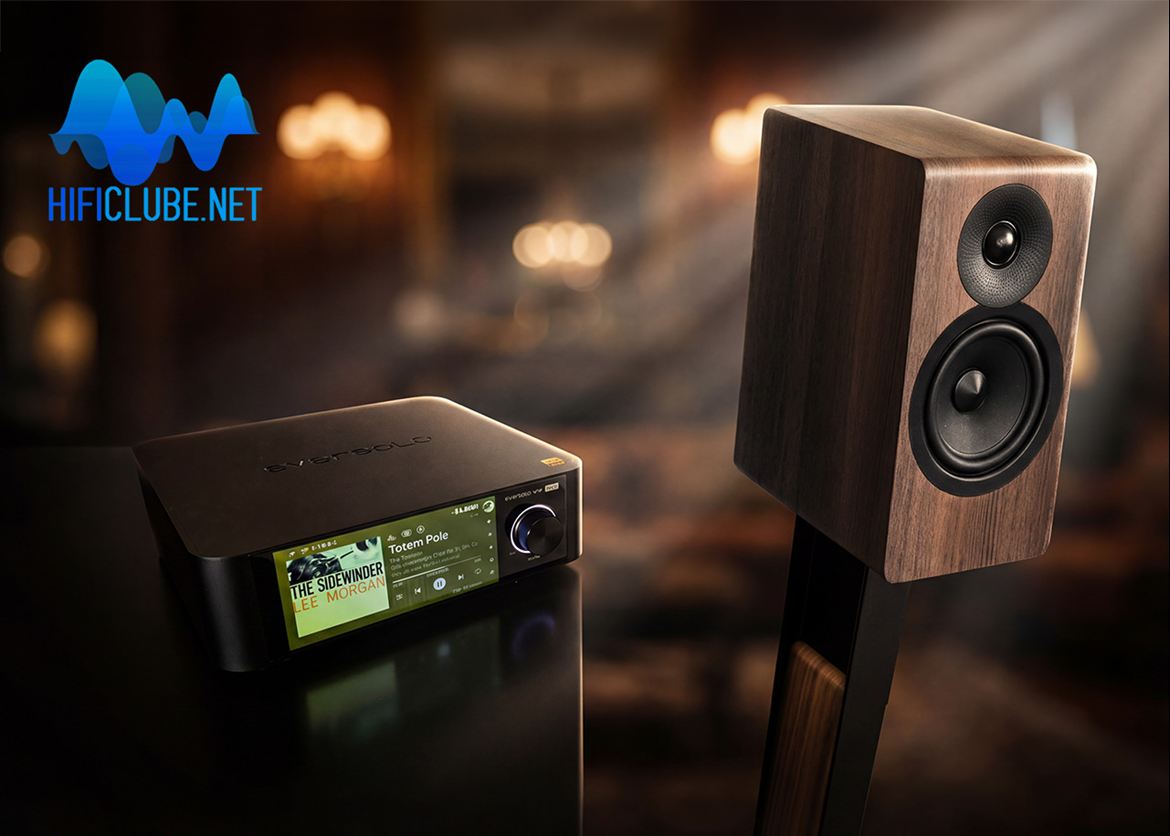
The Acoustic Energy AE300-2 inherits some of the Corinium technology. My pair had Walnut finish. Nice.
AE300 MkII: the Corinium DNA
The AE300 MkII is the latest version of the 300, which already includes some of the technology used in the top-of-the-range Corinium and aims to be a non-disruptive acoustic element in a sound system, consensual and conciliatory: a mature sound, lacking excessive brightness and offering just the right amount of bass, considering their small size (320 × 170 × 270 mm), which categorises them as stand or bookshelf speakers.
Four pillars
This design, manufactured in China but ‘very British, indeed’, is built on four fundamental pillars:
- Resonance control – Cabinet with 18 mm MDF walls, internally lined with bitumen to enhance structural silence.
- ‘Tropical’ woofer – Paper cone reinforced with coconut fibres for rigidity and better damping than metal cones; featuring a conical aluminium phaser to enhance dispersion and integration with the tweeter at 3.5 kHz.
- Dome tweeter – 29 mm fabric dome tweeter (slightly larger than the usual 25 mm).
- Slot port – Selecting a slot at the rear reflex port outlet helps prevent turbulence typical of cylindrical ports, reducing distortion and improving articulation. However, it is not advisable to place them too close to the wall.
Class D: the cheapest watt
The claimed response of 42 Hz to 29 kHz is somewhat optimistic and largely depends on how well it couples with the room at lower frequencies. The sensitivity of 86 dB and the (nominal) impedance of 6 Ω suggest that an amplifier with a power output of 50 W or above would be appropriate.
At the current price per watt, our virtual student should choose Class D, as it costs less per watt, and accept our recommendation of an Eversolo Play or an equivalent device.
Tubes allowed
But the AE300 MkII is not as ‘difficult’ as the figures suggest, because I also fed them with a LAB12 ‘Mighty’ valve amplifier, and they performed very well at normal listening levels, that is, for listening while writing.
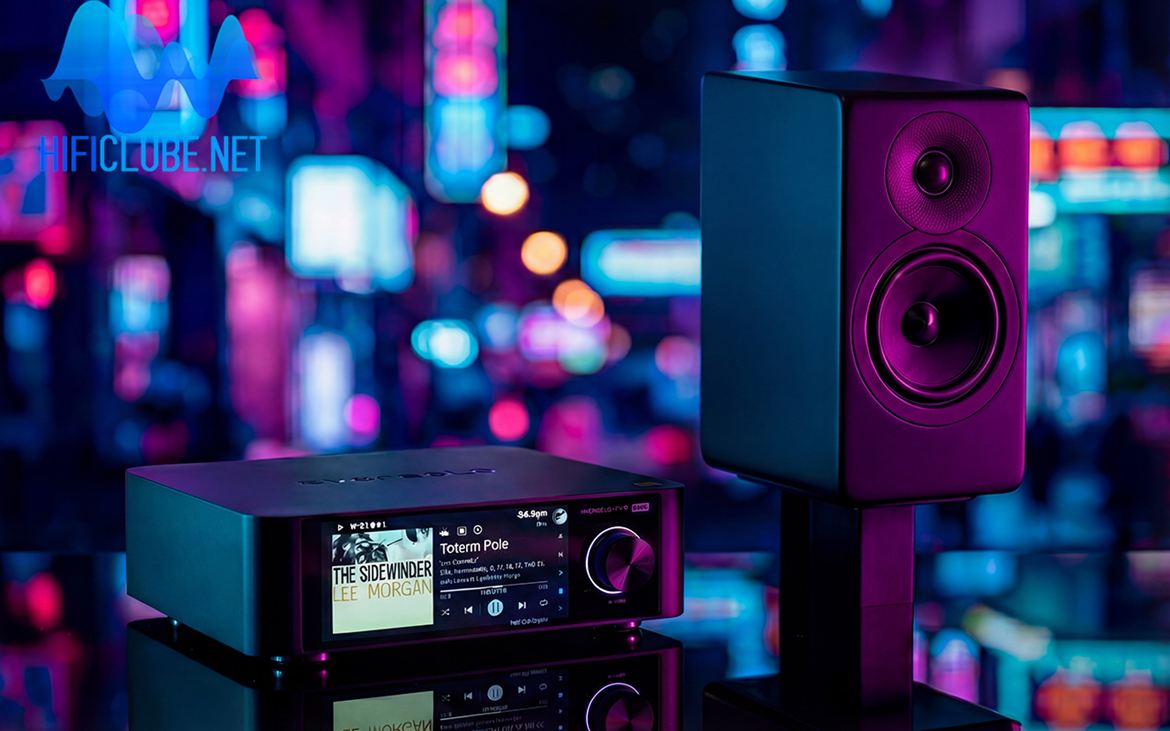
Eversolo Play + AE300MkII work well together, day and night in a tuxedo (black matte). You can also buy them in Walnut and White Gloss.
Eversolo Play + AE300 MkII
Back down to earth, how did the AE300 MkII sound with the Eversolo Play? Civilised. Balanced. Articulate. In a nutshell: restrained at the extremes, without the mids screaming in our ears. And very well integrated: the geometric tangency points between the tweeter and the woofer effectively reflect this acoustic seamlessness. Let them warm up together thoroughly before serving.
A subwoofer might help, or not...
A subwoofer could be useful here, but it would also conflict with the idea of listening to music in the bedroom without disturbing the family or neighbours. It would also spoil the rhythmic sense of the AE300 MkII, which are fast and light on their feet.
Discretion and maturity
The AE300 MkII is a subtle speaker: it doesn't shout, go over the top, or embellish reality. It delivers music with just enough composure, texture, and rhythm. It also has the maturity to evolve as electronics improve, such as tubes. While it is not the most exuberant or bass-heavy among small speakers, it remains one of the most complete and consistently easy to satisfy within its price range.
It's the kind of speaker that will keep you satisfied for a long time without overwhelming the room with excessive bass or drama. It simply plays music in a straightforward, honest manner, and that's part of its charm.
Listen to them at Exaudio or your local dealer.