




JVH heard the B&W 801 D5 in Vienna. Pedro Henriques has now travelled to Worthing, England, to hear them for himself — and to see how they are made. At Southwater, he attended a comparative listening session featuring the 805, 804, 803, and 801 from both the D4 and D5 generations and saw and heard some new, strictly top-secret B&W products. Here is the full story.
In Vienna, the Bowers & Wilkins 801 D5 convinced JVH that the company's massive technological investment over the past decade has finally resulted in a clearly audible improvement. So, what changed?
This time, I went to Worthing on England's south coast, where Bowers & Wilkins still builds the 800 Series Diamond, to find the answer. Curiously, it all begins with very thin sheets of wood, hot-pressed together like a delicious mille-feuille in the oven.
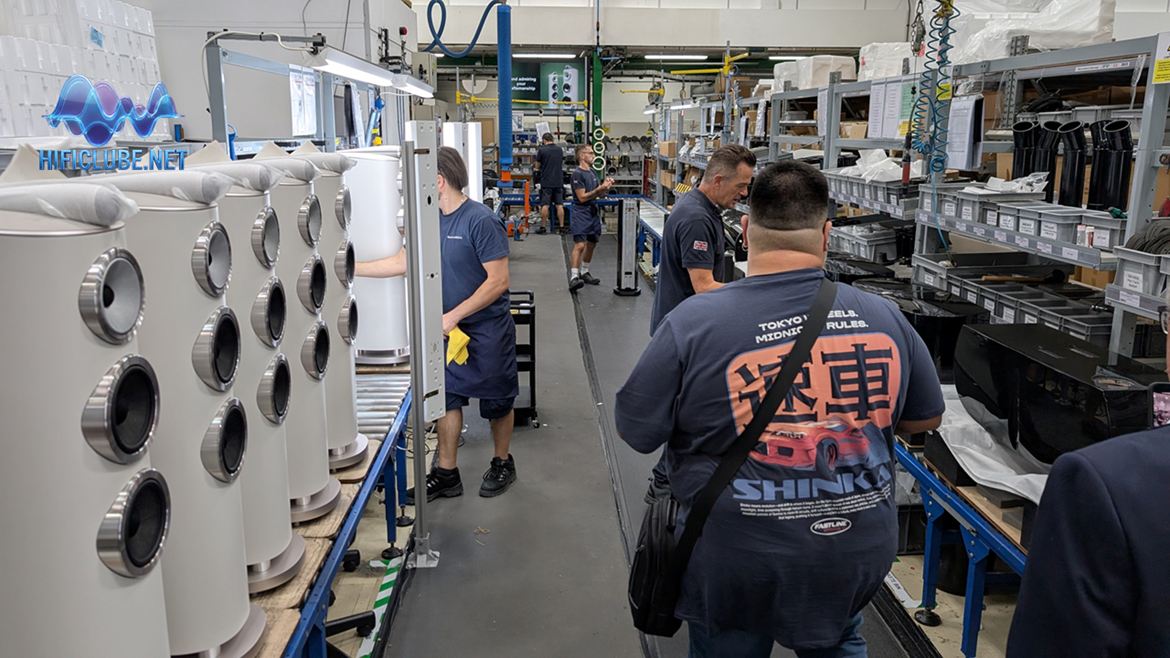
There was a lot of activity (and processing) on the factory floor.
The factory, where engineers and skilled craftspeople collaborate to assemble the 800 Series, is closely tied to the company’s history.
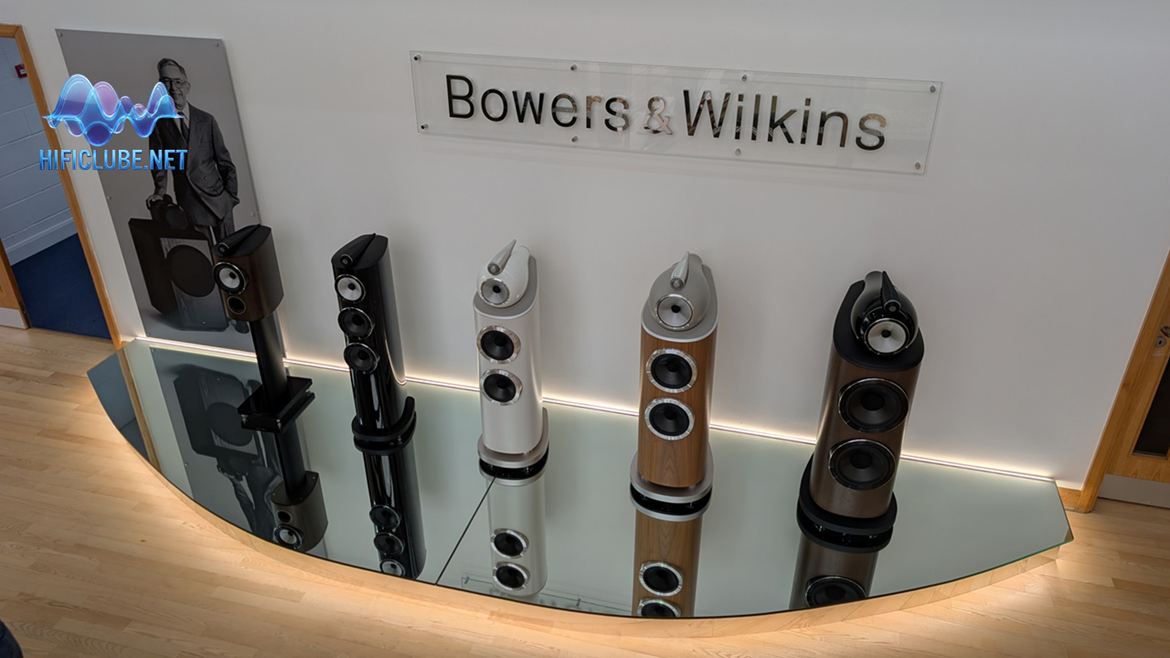
The complete range of the B&W Series 800 Diamond D5. On the left, Sir John Bowers, who, having become rich through inheritance, chose to continue producing high-quality speakers and create jobs in post-war England.
My name is Bowers, John Bowers
John Bowers, who worked for the British Secret Services during the Second World War — a touch of James Bond there — and Roy Wilkins opened a radio and television shop in Worthing in 1946. B&W Electronics followed in 1966, with help from an inheritance Kathleen Knight, an opera singer, left to Bowers after she was delighted to hear her voice reproduced through loudspeakers he had designed.
Sixty years later, they still manufacture the 800 Series here, while research and development has moved to the new Southwater Research Establishment, the successor to the historic Steyning Research Center that JVH, my father, visited multiple times.
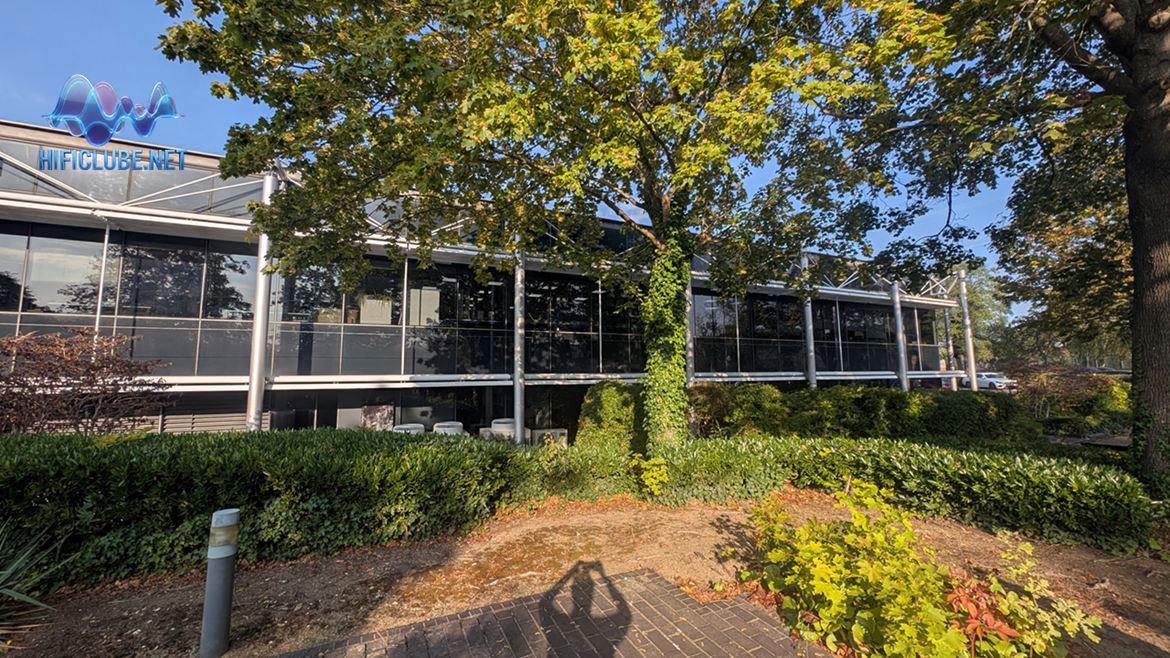
New Southwater Research Establishment
A curvaceous loudspeaker
The external shape of the 800 Series Diamond has become so familiar that it is easy to forget how complex its construction is.
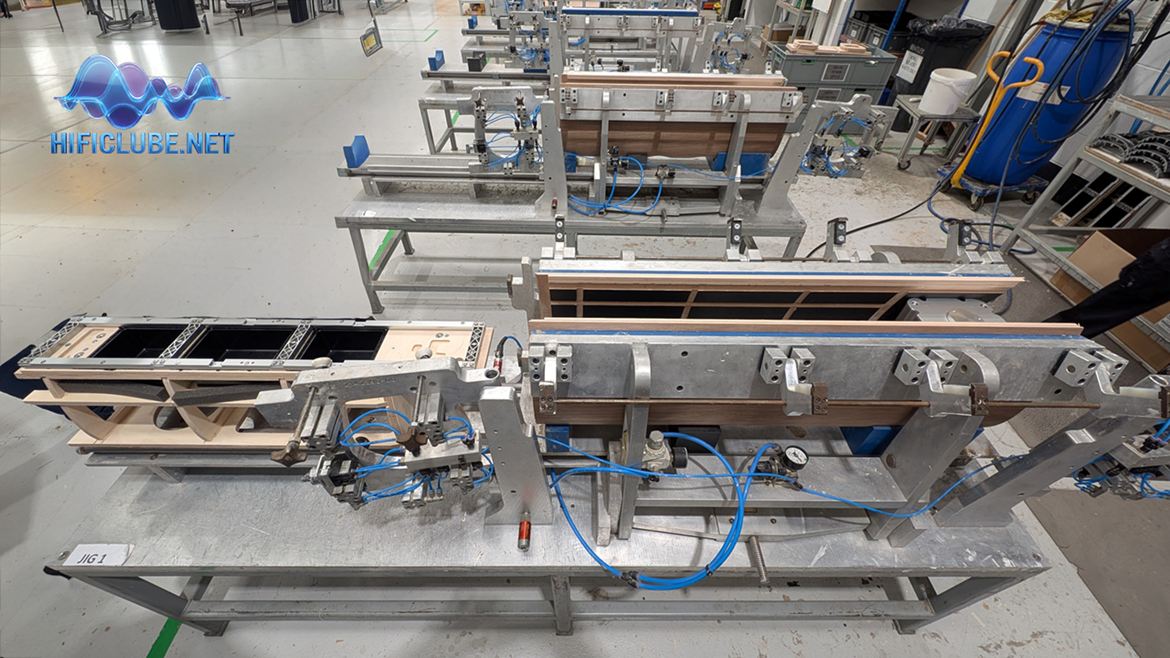
The beech wood sheets are cut and hot-pressed until they take on the reverse curvature known as Reverse Wrap. Andy Kerr, who guided us through the factory, described the massive industrial press as ‘Dickensian.’
Then a five-axis CNC robot takes over, rotating and positioning the cabinet as the machine seems to dance around it with the precision of a classical ballerina. But I only saw it in a video, as the robot appeared to be under maintenance.
Wood is machined to ±0.2 mm tolerance. This was perhaps my first surprise in Worthing: despite all the talk of diamonds, Continuum, Aerofoil, and computer simulation, building an 800 Series loudspeaker ultimately remains an exercise in mechanical tolerances, glueing, sanding, painting, polishing, and human inspection — just like the good old days.
Let machines do what they do best and let people do what they do better—especially where human sensitivity and experience matter more than science.
Filling the belly of an 804 D5
That is also why examining a disassembled loudspeaker is far more revealing than looking at the finished product. From the outside, the 801 D5 looks very much like a slightly restyled D4 — some people even confuse the two. Inside, however, the story is different. The D5 generation's main challenge was to make the cabinet even less audible.
From Matrix to Space Frame
The familiar Matrix structure now features substantial aluminium sections around the front driver apertures — what B&W calls Enhanced Matrix — while the rear gains the new Space Frame Bracing: parallel aluminium rails, reinforced both longitudinally and laterally, and bolted directly to the Matrix.
This is therefore not another marketing invention designed merely to look good in the brochure. The aim is to increase rigidity and prevent the energy generated by the drivers from being converted into ‘music’ by the cabinet — music that no one recorded and no one wants to hear.
The aluminium top plate has also been substantially revised. Its connection to the main cabinet is now even more rigid, with thicker ribs, additional mounting points, and new decoupling for the turbine head. The finish includes Connolly leather and damping material carried over from the D4 Signature.
And then there’s the matter of the plinth.
On the 801 D5, each pedestal combines constrained-layer damping with tuned-mass damping—if you'll allow me to keep using the original technical terms rather than risk losing anything in translation.
The tuned-mass calculations are based on each model's mechanical properties. The principle comes from civil engineering: if a structure is known to vibrate predictably at a specific frequency, a calculated mass can counteract that vibration. Some loudspeakers simply sit on an inert base, whereas the 801 D5 plinth plays an active acoustic role.
Diamonds are forever
Here is one figure that stays with you: the Diamond tweeter dome is only about 40 microns thick and weighs just 88 milligrams! The diamond is grown artificially and shaped into the dome used in the 800 Series Diamond.
The Diamond Dome tweeter retains the familiar 25 mm diamond diaphragm, with no new dome technology announced for the D5. The change is in the protective grille, which now uses the more acoustically transparent mesh first developed for the 801 D4 Signature. According to Bowers & Wilkins, this improves both resolution and off-axis response.
Bowers & Wilkins has also revised the Continuum midrange and Aerofoil bass units, with new, lower-distortion motor systems that use components derived from the Signature specification to improve resolution, transient response, and dynamics.
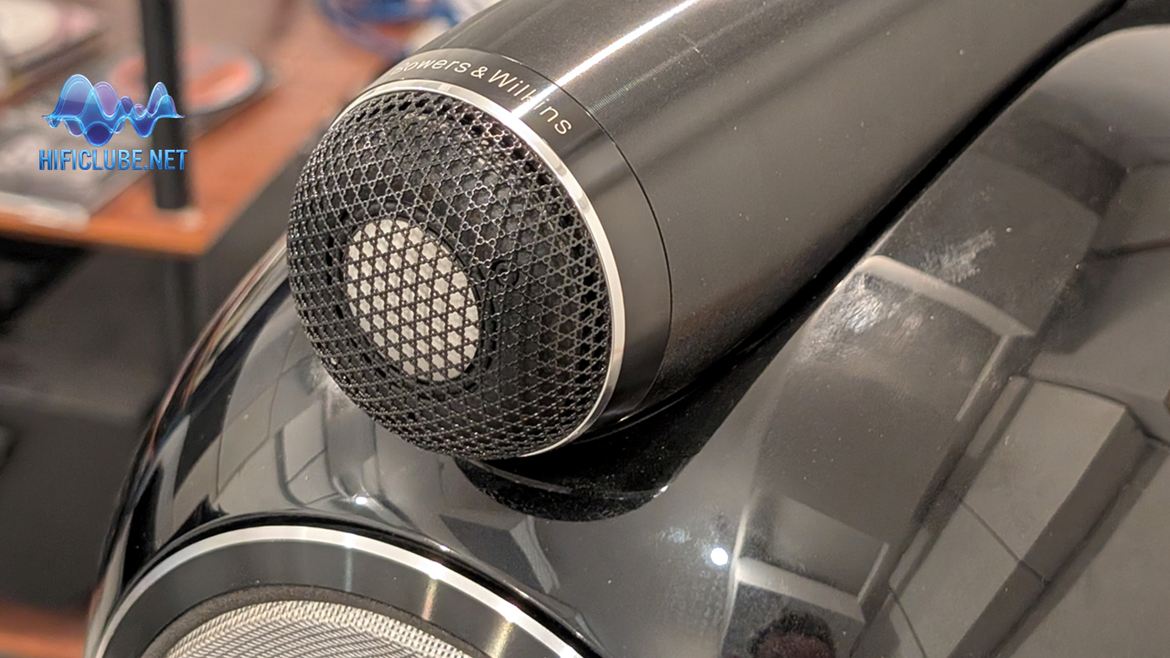
The D5s use a protective grille, with an acoustically more transparent mesh, developed for the 801 D4 Signature
The crossover networks have received similar upgrades, including higher-quality components, new internal wiring, and improved terminal connections. The crossover itself is now mounted on a solid aluminium plate, which is rigidly attached to both the cabinet and the Space Frame using M8 and M4 bolts.
After only a short time in the factory, the D5 philosophy became clear. This time, there is no miracle new driver and no revolutionary new material. Instead, there is an almost neurotic obsession with correcting even the smallest mechanical imperfections in the 800 Series D4.
That also helps explain why the 801 D5's specifications look so similar to the D4's, while the sound is so much better—exactly as JVH had already noted in Vienna.
Pass inspection with flying colours
Every drive unit and cabinet is inspected before final assembly. Production uses Klippel measurement systems to monitor frequency response, distortion, and impedance and applies objective pass/fail criteria.
It is not simply a matter of listening to a finished loudspeaker and deciding that it ‘seems to sound good’. Seeming good is not enough: anything outside tolerance must be rejected.
Andy Kerr, who gave us an extensive presentation covering every technical aspect of B&W, sums up the company’s philosophy in one word: precision. He says the ambition is for B&W to be regarded as a performance brand, like McLaren, rather than as a luxury brand such as Rolls-Royce.
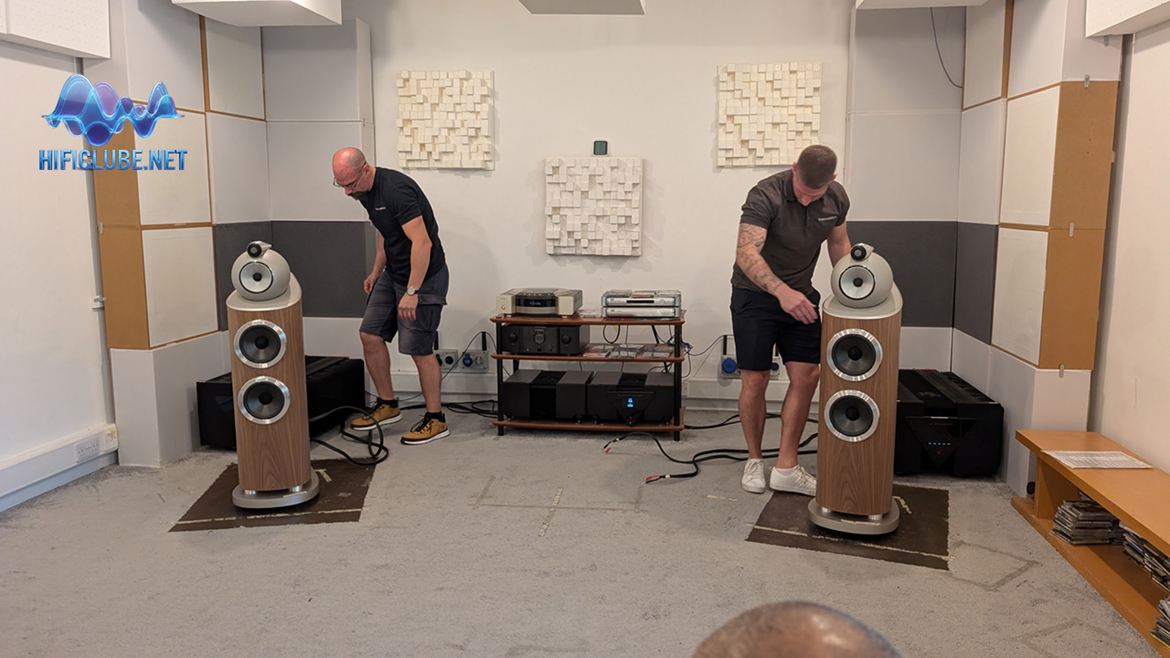
The Dance of the Speakers in the complex but efficient audition process.
From the factory to listening room
The most interesting part of the press presentation took place at the new glass-walled Southwater Research Centre, where guests could compare several D4 and D5 models side by side.
No appeals to auditory memory — which, in my case, would have been especially pointless, since I had not heard the D5 in Vienna. Here, the D4s always played first, and the D5s second: 805, 804, 803, and 801. Same room, same system, same music.
And what a room. It is built on a suspended foundation, much like an anechoic chamber, to eliminate unwanted resonance and vibration.
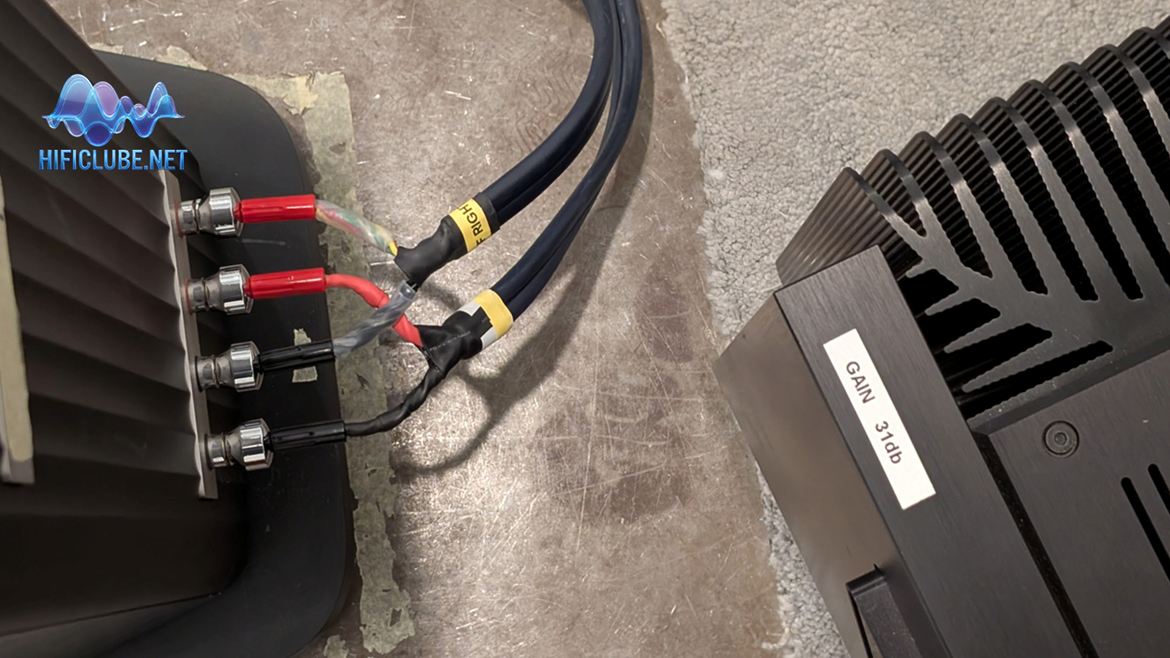
All speakers were bi-cabled using a pair of stereo amplifiers, not monos.
The electronics included an old Denon DP-S1 CD transport, an MSB Platinum Diamond DAC with a separate power supply, a Gryphon Commander preamplifier, and two enormous Gryphon Apex Stereo Class A power amplifiers in a bi-wired configuration.
Oh, and 16-bit CDs!
Apparently, no one felt the need to play 768 kHz files to demonstrate a pair of €50,000 loudspeakers…
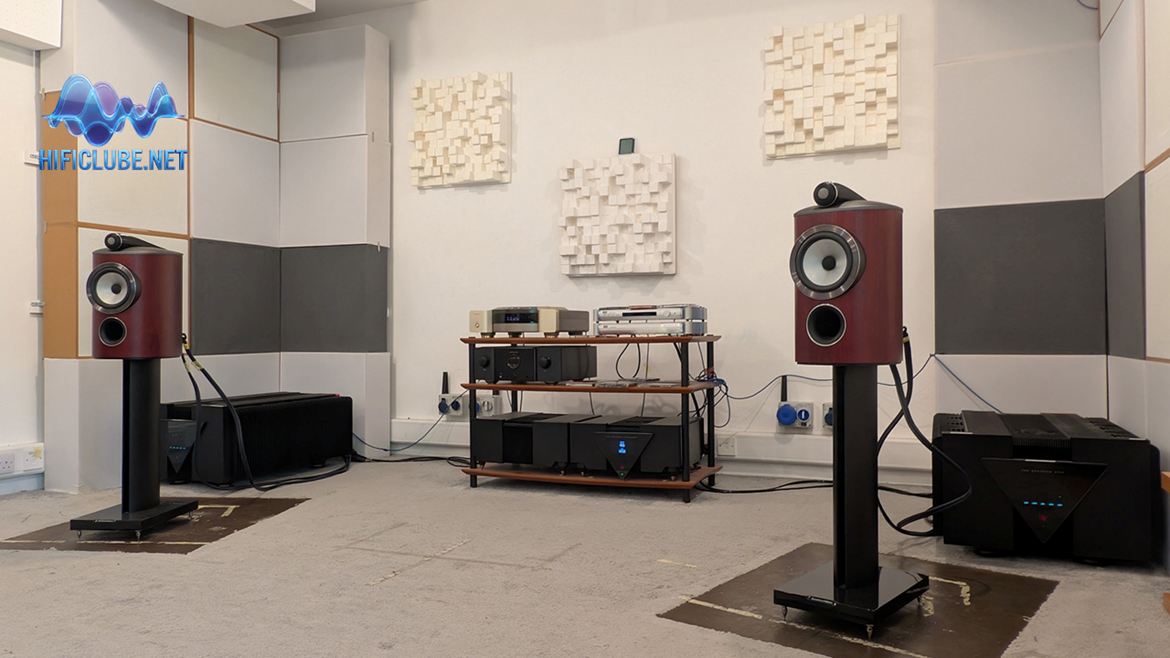
The 805 D4 (a unique and unrepeatable red color not available in the D5 range opened the multiple speaker .audition
I do not have my father’s listening experience, but I arrived armed with his notes from the Vienna session and, throughout the comparison, heard the same pattern as we moved from D4s to D5s. The character was unmistakably B&W, yet the D5S consistently delivered greater transparency, clarity, dynamic definition, and a more convincing sense of space.
For me, however, the biggest difference came when I compared the B&W 803 D4 and D5. The improvement was especially clear in the 803 D5. As so often happens, though, the flagship models ultimately deliver the finest results — even though I was sitting well to the right of the sweet spot.
What impressed me most about the 801 D5 was its ability to reveal depth in the mix, aided by greater bass tension, extension, and intensity, and by a complete absence of hardness, even at high listening levels. These were precisely the qualities JVH highlighted after hearing them in Vienna, which I confirmed through my own listening—even though he didn't have the D4 in Vienna for a direct comparison.
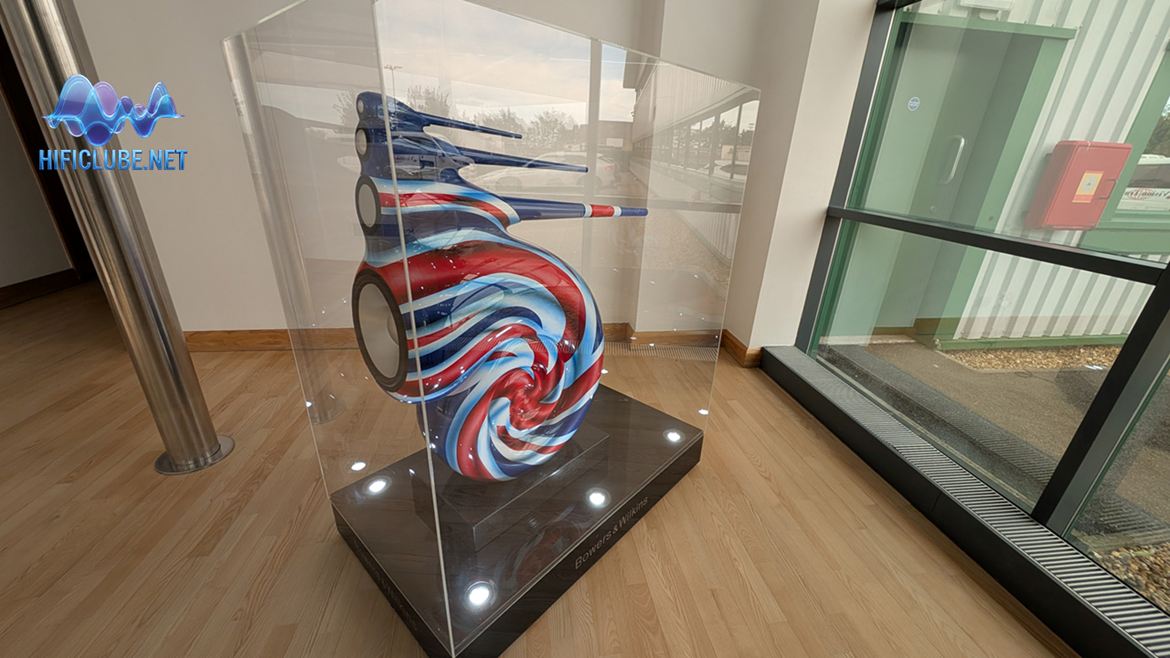
The legendary Nautilus proudly displays the colors of the United Kingdom. Still, 50 pairs are produced each year!
Less loudspeaker. Less sound. More music.
Andy Kerr perhaps offered the best explanation of what the D5 generation aims to achieve. According to him, the D5 Series brings three fundamental advances: a more balanced, pleasing tonal character, even with less-than-perfect recordings; less audible cabinet presence—the vanishing act; and higher resolution, achieved not by adding more information but by reducing the noise that previously masked it.
In JVH’s view, ‘high resolution’ in B&W’s flagship loudspeakers had long been associated with increased brightness and sharper edges in the mix. Here, the thinking has shifted in the opposite direction.
Reduce the mechanical noise of the cabinet, the distortion generated by the driver motors, crossover interference, and spurious driver vibration, and you hear more music — even if, paradoxically, you may hear less ‘sound’.
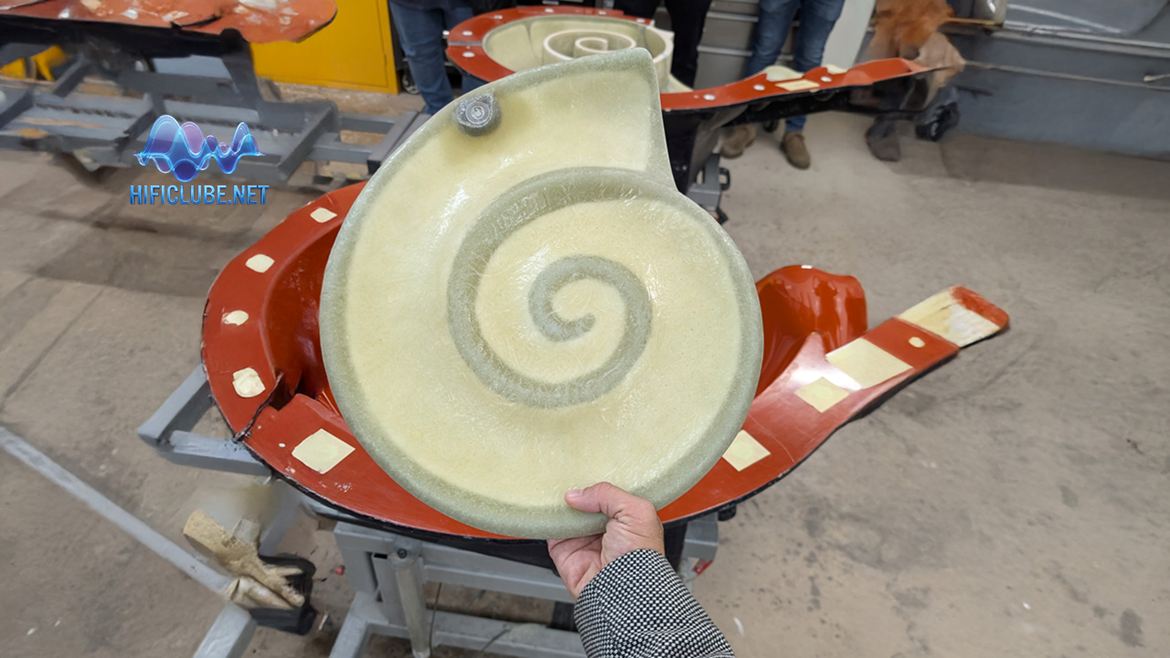
Your humble chronicler holding in hand one of the Nautilus bass section moulds.
According to Kerr, the 801 D5 approaches the legendary Nautilus in its ability to disappear acoustically, while adding dynamic scale and resolving power the original Nautilus lacks. In Vienna, my father came away with the impression that Laurence Dickie himself might even agree with this bold claim.
‘Top Secret’
The 800 Series Diamond D5 is clearly a step forward from the previous generation. Unfortunately, we might not be able to confirm this with a controlled side-by-side comparison at home.
Still, I would be quite happy to hear them again at the Southwater Research Centre — next time, preferably seated in the sweet spot.
I also saw and heard about new ‘top-secret’ products I am not allowed to disclose. Much like Las Vegas, what happens in Southwater stays in Southwater.
At least for now…
From Harman to Samsung
After several ownership changes, Bowers & Wilkins is now part of Harman, which is integrated into the Samsung ecosystem. This raises the inevitable question: will the 800 Series continue to be manufactured in England when the more affordable ranges are already made in China?
Nobody can guarantee the future, but decades of accumulated experience at the Worthing factory can't simply be transferred to the other side of the world. The people working here collectively embody hundreds of years of knowledge and expertise. That can't be easily replaced either.
For now, there are no signs of investment cuts. Quite the opposite: new ‘secret’ projects are already in development, as I mentioned earlier.
Keeping a factory in England in the age of globalisation is certainly not the cheapest option.
But for a legendary name like Bowers & Wilkins, it may be the only one that still makes sense.
‘The best loudspeaker isn’t the one that gives the most. It’s the one that loses the least.’
When less is more
A pair of 801 D5 loudspeakers costs about €50,000. Each loudspeaker weighs 106.4 kg and uses the same basic driver complement as the D4: a 25 mm Diamond Dome, a 150 mm Continuum FST midrange, and two 250 mm Aerofoil bass drivers. The basic architecture remains unchanged.
So, at first glance, nothing changed. Right?
Well, once you visit Worthing and see the wood bent under heat and pressure, the five-axis robot, the aluminium bracing hidden inside the cabinet, the diamond tweeters, the crossover bolted to a metal structure and every unit subjected to Klippel inspection, you realise that quite a lot has changed after all.
It is simply that, to borrow from Camões, ‘love burns unseen.’
In the end, John Bowers had summed it up long ago:
‘The best loudspeaker isn’t the one that gives the most. It’s the one that loses the least.’
Sixty years later, in Worthing, less is still more.
Long Live the King!
Pedro Henriques
Note: Hificlube thanks B&W/Harman and Alex Obrado, through AEM Press, for the invitation to visit the Worthing factory and the new Southwater Research Centre.