




At High End 2026 in Vienna, we witnessed the revival of the Orthophase cell, a French technology developed in the early 1960s that had since disappeared.
There were dozens of products in Vienna that we only briefly mentioned or simply passed by, as it’s impossible to cover everything in detail.
To keep our coverage from becoming chaotic, we need to establish a focus, typically targeting the brands distributed by our sponsors and others that—due to their quality, innovation, exclusivity, and—why not—extravagance—capture the attention of visitors and readers.
Today we’ll discuss the Thierry & Wango speakers, which use a rare French planar technology from the 1960s, revived in Hong Kong and presented to the world at HIGH END Vienna 2026.
As is always the case in our reports, T&W was mentioned here, along with many other brands—even those not represented in Portugal. However, the exclusivity, acoustic quality, and build quality of the T&W speakers warrant a more detailed presentation, in the hope that a Portuguese importer will take an interest in them.
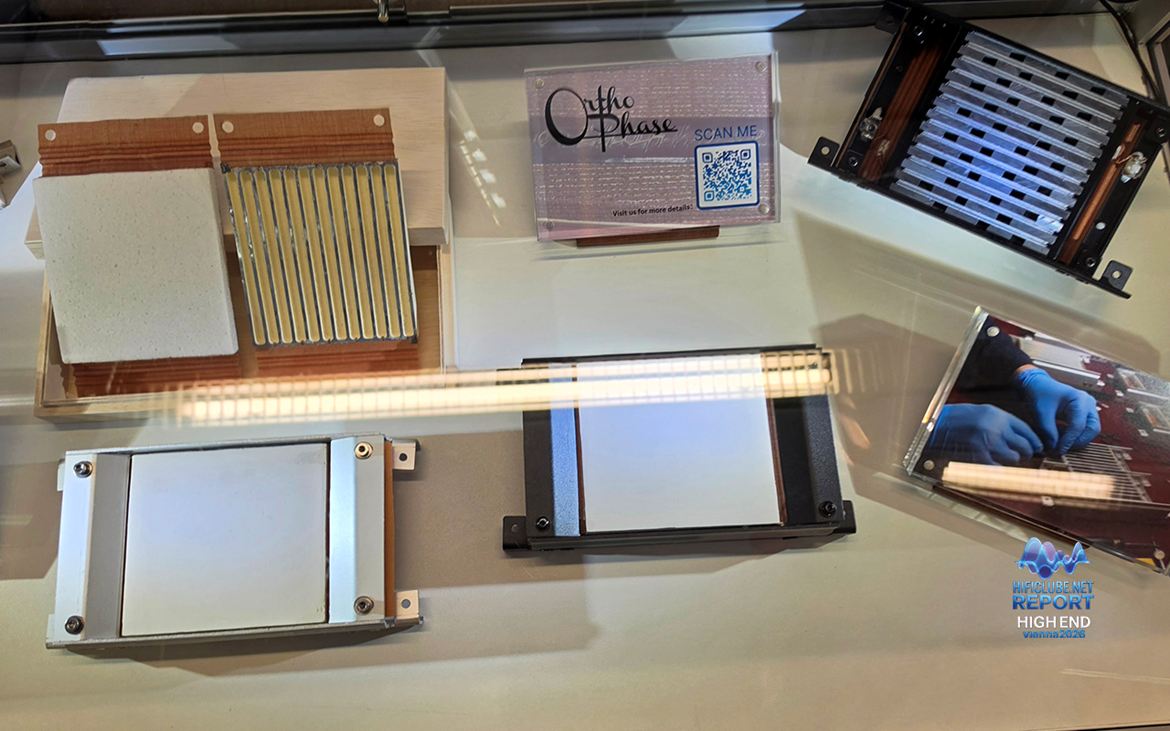
Display of the different components and construction stages of the Orthophase driver.
Vive la France!
The origins of Orthophase trace back to the studies of the Frenchmen Georges Gogny and Georges Poutot, who pioneered an approach to planar loudspeakers that was publicly demonstrated at the Salon International des Composants Électroniques in Paris in 1962. That model employed six flat-membrane cells arranged vertically.
Decades later, the Frenchman Thierry Cirot—a surgeon by profession and an audiophile by vocation—became deeply interested in the technology, collected some original units, and began a long process of study and reconstruction. Between 2013 and 2017, the cell was analysed, disassembled, and gradually recreated.
Meanwhile, in Hong Kong, Wango Lee—who, in his youth, had listened to an Orthophase system and never forgotten the experience—learned of Cirot’s work. Their collaboration secured the necessary technical rights and led to the founding of Thierry & Wango Audio.
Therefore, this is not merely a matter of attaching a historic name to a modern speaker. T&W aims to revive the original principle and adapt it to today’s materials, production methods, and requirements. Each driver is hand-assembled in Hong Kong, including the delicate process of bonding the aluminium conductor to the expanded polystyrene diaphragm.
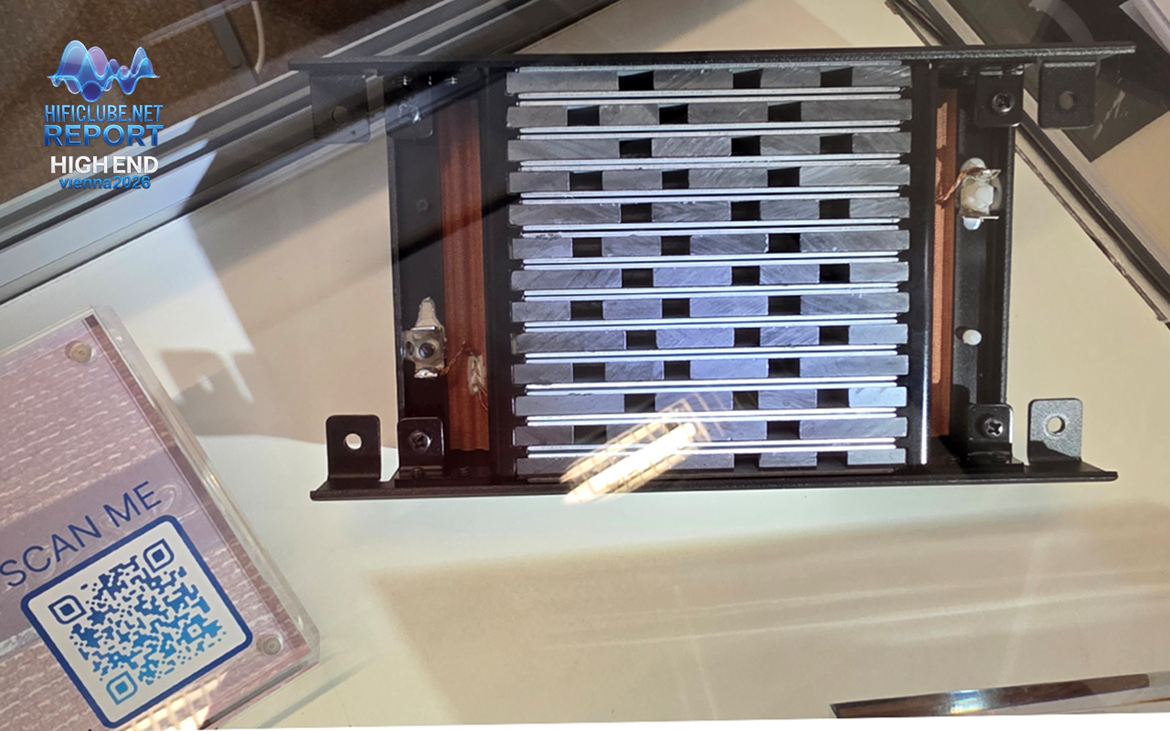
Metal structure with the magnets that generate a push-pull magnetic field.
What is an Orthophase driver?
In a conventional loudspeaker, a circular voice coil drives a cone from a relatively small area. In an ATB2G planar-magnetic or isodynamic unit, the conductor is distributed over a much larger area of the diaphragm, allowing the driving force to be applied more uniformly—hence the term “isodynamic,” meaning “equal force” across the entire surface.
Orthophase adds an important feature: instead of a very thin, flexible film, it uses a flat, rigid, and extremely lightweight expanded polystyrene diaphragm, onto which a continuous aluminium conductor is applied in a sinuous pattern.
The diaphragm membrane is suspended between magnetic grids, which cover the entire surface behind and in front of the diaphragm, and vibrates within the field they generate.
When an electric current flows through the conductor, the magnetic force acts virtually on its entire surface. The intention is for the membrane to move back and forth like a flat piston, thereby reducing localised deformations, energy storage, and phase differences across the diaphragm.
The photographs we took of the cells on display are particularly illuminating. In one, we see the white polystyrene plate and the pattern of the conductive strips; in the other, the magnetic structure with its parallel bars.
The explanation they kindly provided was a practical hands-on lesson in the anatomy of an Orthophase transducer.
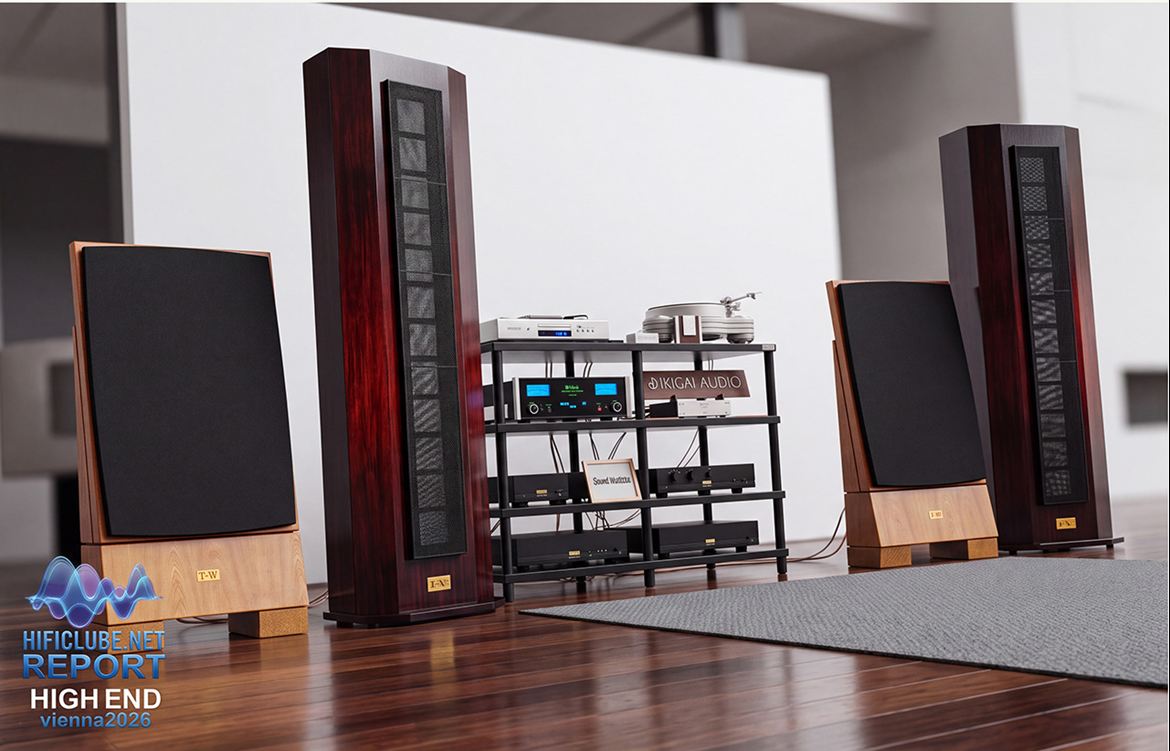
The T&W V12.1, with twelve Orthophase drivers; and the three-driver V3.1. The system used McIntosh electronics and Ikigai Audio cabling.
Full range
T&W’s concept avoids the usual combination of a woofer, midrange driver, and tweeter. Each Orthophase cell is designed to operate across the full frequency range. Several identical cells are then connected and aligned vertically.
This eliminates the need for a crossover to divide the spectrum among drivers with different masses, materials, and dispersion patterns. The aim is to preserve temporal and timbral continuity through a homogeneous radiating surface. The V Series was therefore presented to us as a dipole system with a linear source and no crossover.
In the same room (see photo), the two models already available in the V Series were showcased: the 3.1 and the 12.1. We listened exclusively—and with great pleasure—to the V12.1, the top-of-the-line model.
The V12.1 uses twelve drivers mounted in a tower approximately 1.64 m tall, 49 cm wide, and 21 cm deep. It weighs about 45.4 kg and handles up to 200 W.
The rated sensitivity remains at 90 dB and the nominal impedance at 4 ohms. The frequency response seemed a bit optimistic to us (5 Hz–40 kHz, ±3 dB), but during the listening session, both Pedro Henriques and I felt we were listening to a true full-range speaker, perfectly in phase.
In V12.1, the twelve drivers form a long vertical line. The geometry is designed to approximate a cylindrical wavefront, reducing level loss with distance and improving uniformity between seated and standing positions.
T&W claims that the V12.1 delivers sound consistently from floor to ceiling. This is one of the characteristics we’d most like to confirm during an extended listening session in a familiar room.
Like any dipole, the T&W V12.1 radiates sound both forwards and backwards, with strong lateral cancellation. This can reduce certain reflections off the side walls, but it makes the distance from the wall behind the speakers crucial. These speakers are therefore not intended to be placed flush against a wall or hidden among furniture.
This is our first postcard from Vienna for your summer reading. We hope you enjoy it. Stay tuned for more news, between cocktails and a dip in the pool.
For further info, please contact: