


The Z-10 is not merely about converting zeros and ones into music; it also serves as a reference preamplifier, featuring resistor-based (R2R) volume control and a high-quality headphone amplifier with ample power. It lacks a streamer; I get that. However, the Z-10 is not intended as an all-in-one device; rather, it is a specialist device that also functions as a digital/analogue hub.
Dressed in black
The Z-10 arrived from China, dressed up in a sleek black aluminium box with simple, straight lines. It presents itself as a sturdy industrial product that, despite the low-relief grooves for side heat dissipation, maintains a distinctly austere appearance. The only control is a rotary knob on the right, which adjusts the volume and also serves to power the device on or off. On the left, there is the innovative single 6.3 mm headphone jack—about time, Eki!
When powered on, the Z-10's display lights up with a broad smile of light and colour, and the room comes alive with a spectacular collection of lively VU meters. However, the 8.8-inch IPS panel is not merely decorative: it informs, controls, and monitors, acting as a true cockpit:
- • Input selection (USB/AES/optical/coaxial/I²S/HDMI ARC/eARC/Bluetooth), without the need to hunt for hidden buttons;
• Clear volume indication when used as a preamp;
• Digital signal lock status;
• Sampling rate and format (PCM/DSD), so you can be sure you are hearing what you think you are hearing;
• Playback/input status and mode (e.g., ARC/eARC active when the TV is in use);
• And, depending on the configuration, additional data to help you get the most out of it: digital filters, extra gain, etc.
The display is an electromagnetically shielded touchscreen—a small but telling detail for those who use it near a TV screen.
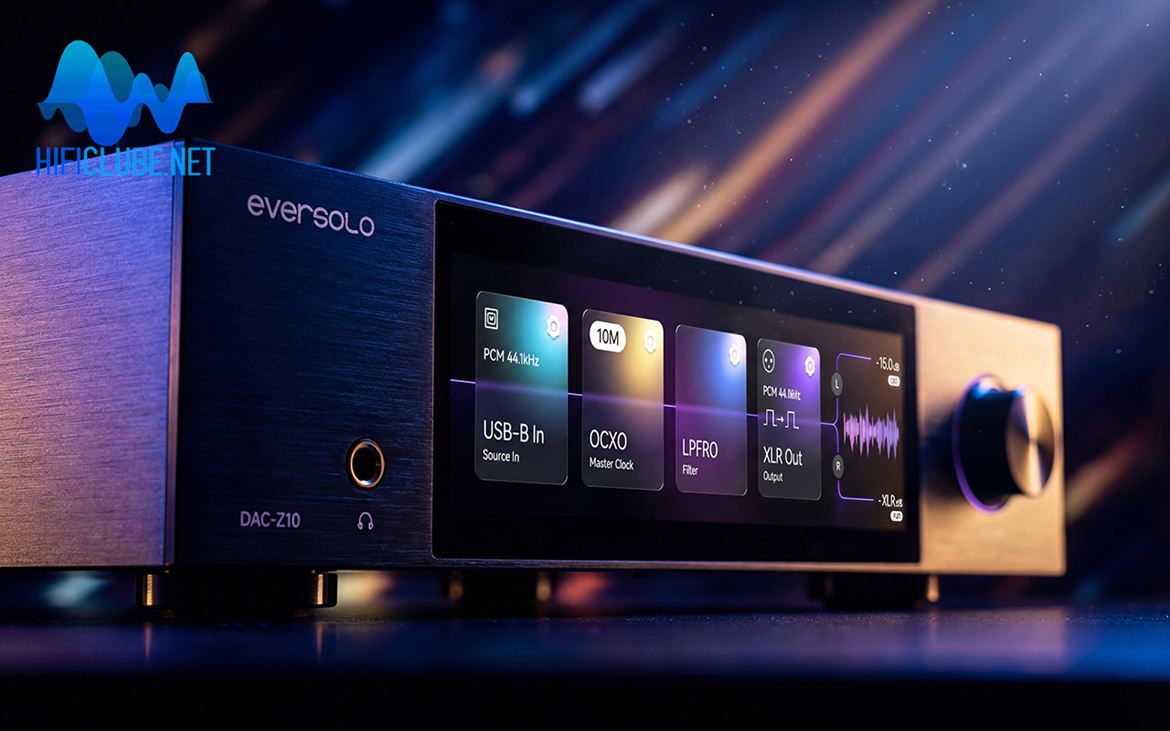
Signal Path Display: all you need to know about what's happening to the signal.
Signal Path Display
Eversolo calls it “Signal Path Display”: a live, colour diagram showing how the Z-10 is operating and displaying the signal path in real time. From the active input to the outputs (XLR/RCA); from the format and sampling rate to the selected digital filter (6X); from clock status (referring to the master clock) to the heartbeat of the R2R volume-control circuit and channel balance, with its dynamic electrocardiogram.
It is the ideal device for those who enjoy tinkering and fine-tuning without having to guess or consult paperwork—in other words, without resorting to the manual.
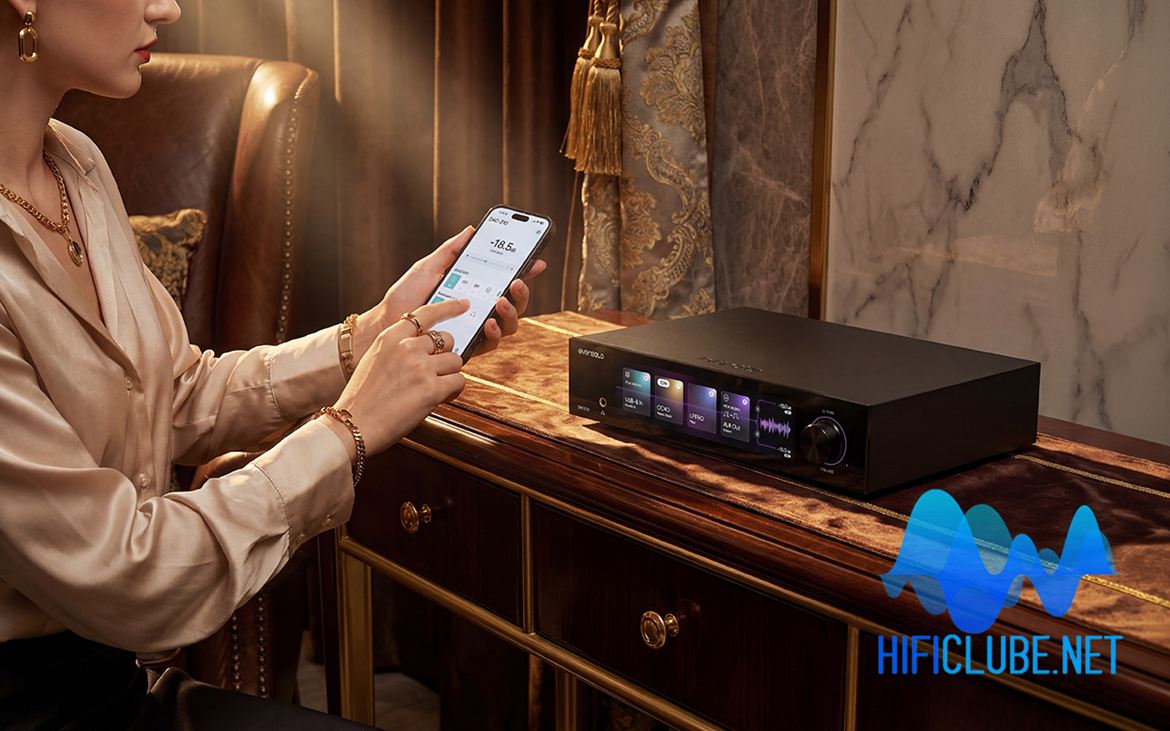
With the Eversolo Control, the power is in your hand.
Eversolo Control
You can navigate the display with the classic (limited) remote control or with the Eversolo Control (iOS/Android) app, depending on your ecosystem.
The app controls all the device’s functions — and, on the Z-10, that translates into practical features such as selecting inputs, choosing the output port, adjusting the volume, and tweaking settings (filters, parameters, and the like).
Fully Isolated Architecture
On the outside, the Z-10 behaves as an ergonomic, cohesive unit, responding immediately to tactile or remote commands.
The philosophy behind the internal digital/analogue architecture is another matter: it separates to avoid mixing and isolates to prevent contamination. The goal is not to correct noise after it occurs, but to prevent it from entering in the first place. Processors, FPGAs, USB/I²S interfaces, clocks, and similar components are sources of switching noise to which the analogue signal is highly sensitive.
For the Z-10, Eversolo opted for three independent toroidal linear power supplies: one for the left channel, one for the right channel, and one for the “system” (the logic circuits), keeping these blocks isolated from one another.
In other words, total physical and electrical separation of digital and analogue stages and left and right channels. When done properly, the practical result usually appears where it matters: a blacker background, greater microdynamics, and a sense of order when the music becomes complex.
The “Fully Isolated Architecture” topology is more than just a marketing term. The RCA/XLR analogue inputs and outputs for the right and left channels on the rear panel are well separated and not clustered together with the digital ones, as is often the case.
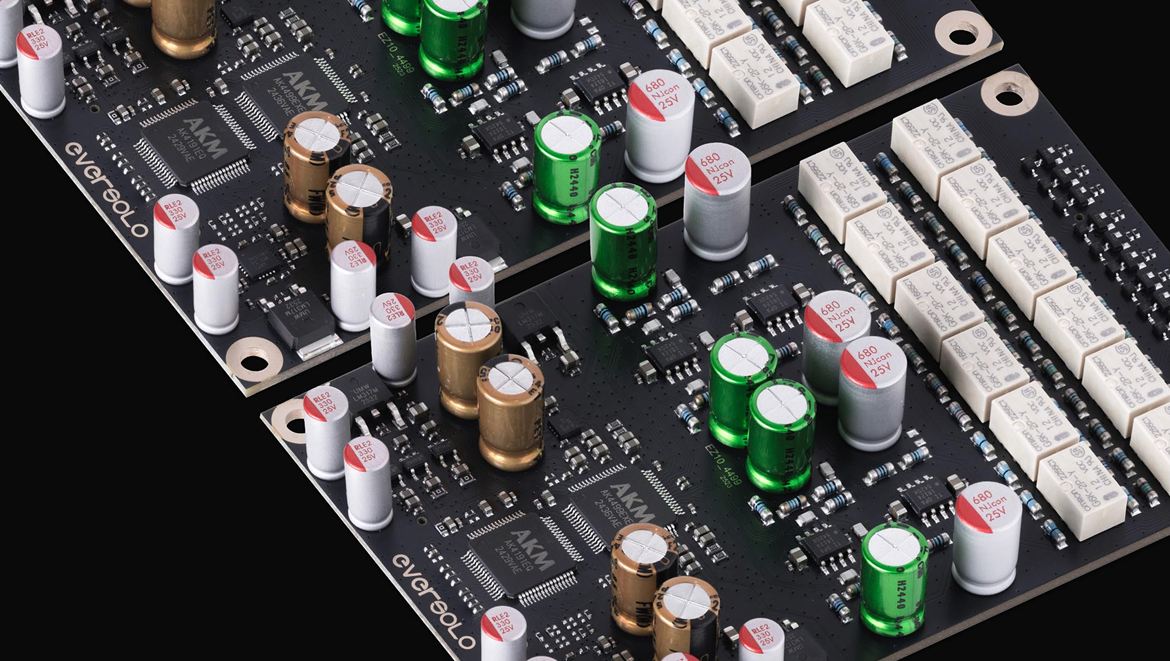
The Eversolo Z-10 boasts dual AKM Velvet Sound modulators/converters (photo courtesy of Eversolo)
Full symmetry
The dual-mono architecture also extends to the digital section, with independent AKM modules per channel: AK4191 (modulator) + AK4499 (converter) for the left channel and another identical set for the right, in a balanced/symmetrical approach that reduces crosstalk and common-mode noise, thereby improving dynamics.
Beyhond what human ear can resolve
It is no coincidence that the measurements are also impressive: THD+N via XLR is around 0.00008% (−122 dB) and via RCA is 0.000097% (−120 dB), with SNR/DNR around 124 dB.
In practice, this corresponds to an electrical transparency that is very difficult to surpass, and no amplifier or loudspeaker comes even close — let alone the human ear — so these numbers are largely academic. But they say a lot about the product’s electrical competence.
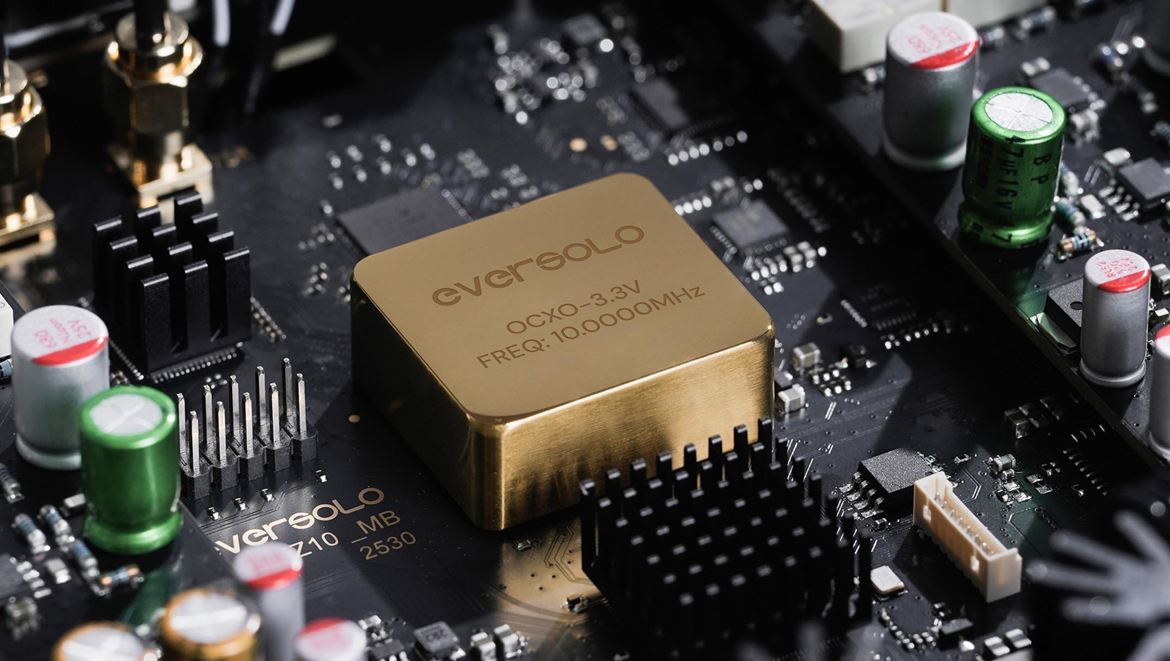
OCXO (temperature-controlled oscillator) for clock reconstruction (photo courtesy of Eversolo)
External clock option
The Z-10 has another feature that is unusual at this price point, up to €2,000: an OCXO (temperature-controlled oscillator), a PLL, clock reconstruction via FPGA, and even an input for an external 10 MHz and 25 MHz clock—all to fight that silent enemy: jitter.
Better still, those external clock inputs offer 50 Ω and 75 Ω impedance options, which is exactly the sort of detail you normally don’t see at this kind of money.
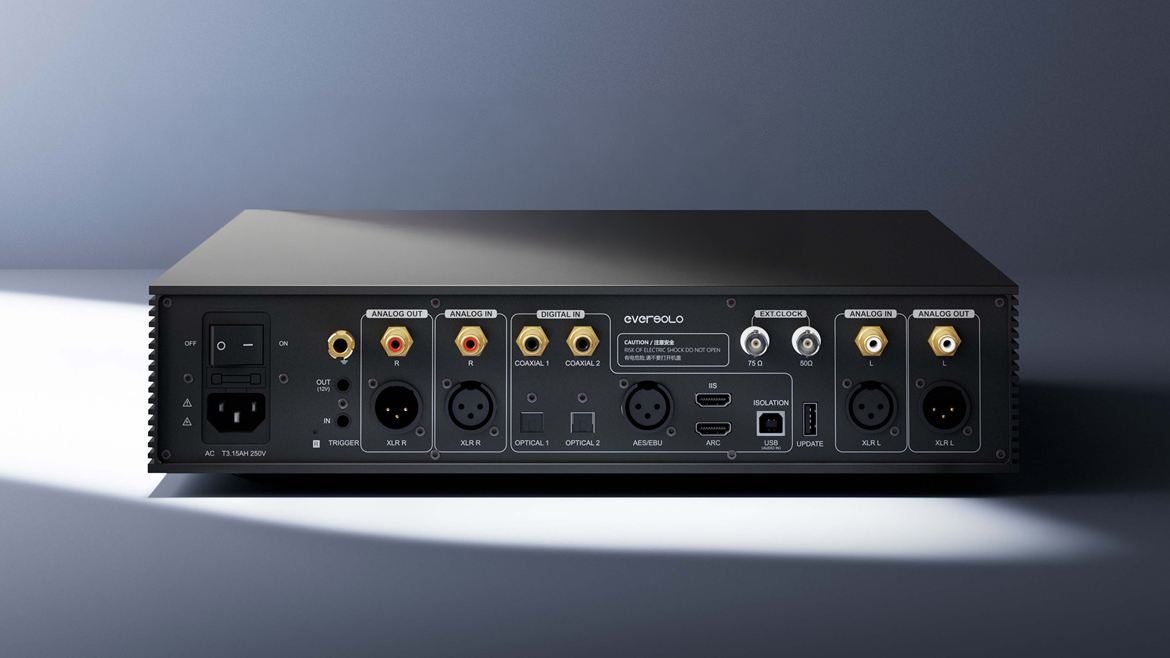
At the back you have a comprehensive set of digital and analogue connections.
Seen from the back
The rear panel is a godsend for those with multiple digital sources:
- • USB with high-resolution support (including PCM up to 768 kHz and DSD512);
• I²S (IIS) via HDMI, with eight modes/compatibilities (which matters for those with digital transports, streamers, or players with I²S output);
• HDMI/eARC, which is the difference between an “audiophile DAC” and a “DAC that works properly in a real room with a TV”;
• AES/EBU, two optical, two coaxial — useful redundancy for those who have more than one transport and don’t want to keep changing cables. Great for quick A/B comparisons;
• Qualcomm Bluetooth (QCC5125) for practical use (not the “purist” way, but a good Plan B — and in many homes it’s even Plan A);
• And a small detail that many only use with turntables: the grounding terminal, which can eliminate hum in more complex systems.
Note: Bluetooth codec support is specified as SBC/AAC—LDAC/aptX is not mentioned in the manual—so treat it as a convenience rather than the last word in wireless audiophilia. You can’t have everything, after all.
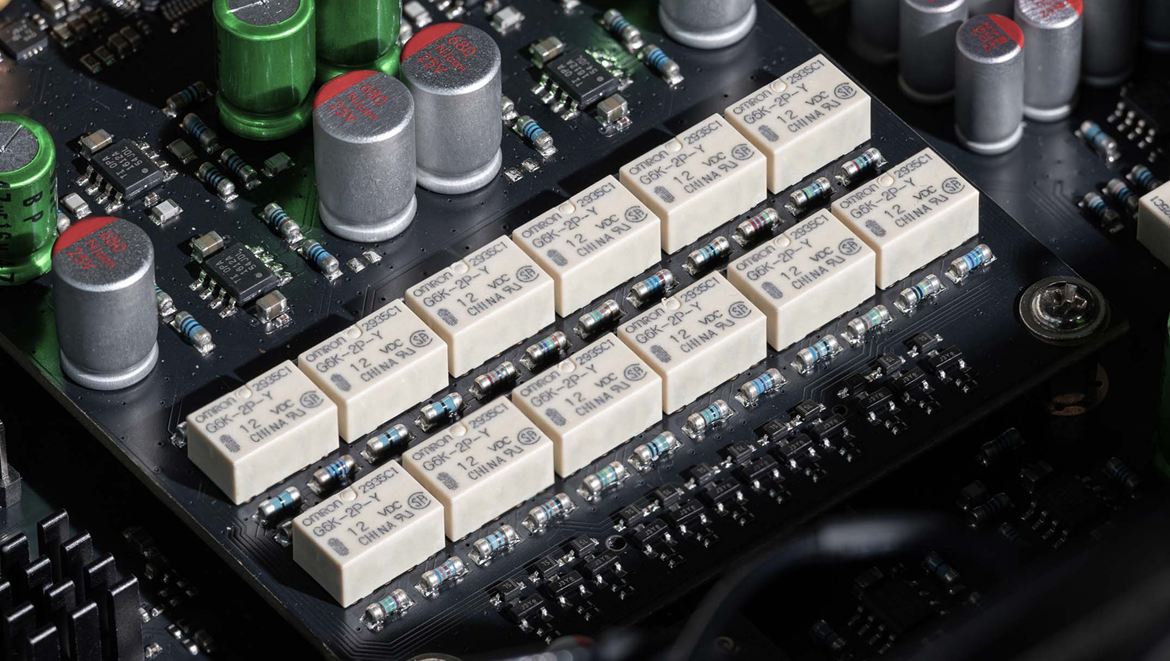
R2R array of precision resistors to control volume and channel balance (photo courtesy of Eversolo)
Reference R2R preamplifier
The Z10 is also a “proper” preamp for line sources (RCA and XLR), allowing you to bring to the party whatever you still use because you like it—a cassette deck or an FM tuner—alongside the paraphernalia of digital sources.
The preamplification stage is part of the overall high-quality concept, and, instead of reducing volume by cutting bits, it uses a high-precision R2R network with fine control and predictable volume behaviour in 0.5 dB steps (up to 10 dB of gain), plus channel balance adjustment (up to 15 dB) all in the analogue domain. In plain English: it can drive power amplifiers or active speakers directly — no separate preamp required.
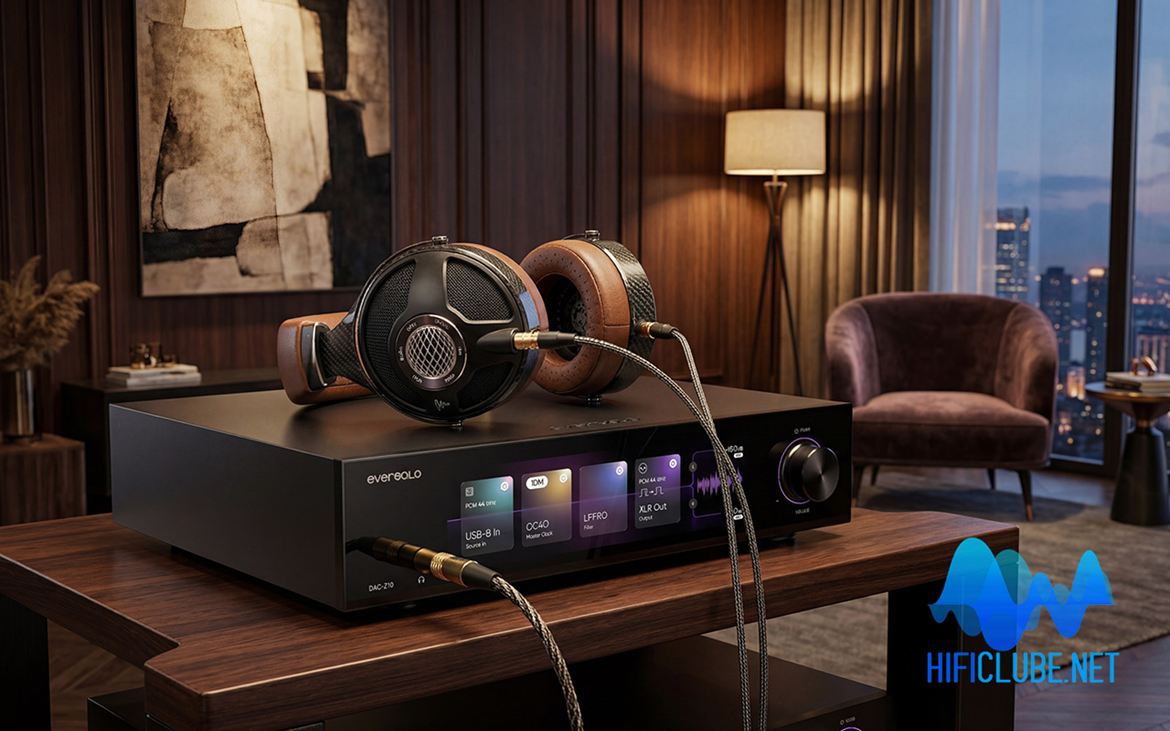
The Z10 can drive even the most demanding headphones with ease (1W/16/32 ohms!)
Purist headphone amplifier
On the front panel, the only output is the 6.3 mm headphone jack. Some manufacturers add a headphone socket, like someone putting a lighter in a car’s dashboard — just in case it might come in handy one day.
In the Z-10, headphone listening is treated as a serious function, with automatic impedance and gain-level detection and a suggested volume adjustment. Instead of the usual “it’ll do”, the Z10 can drive even the most demanding headphones with ease (1 W into 16/32 ohms!).
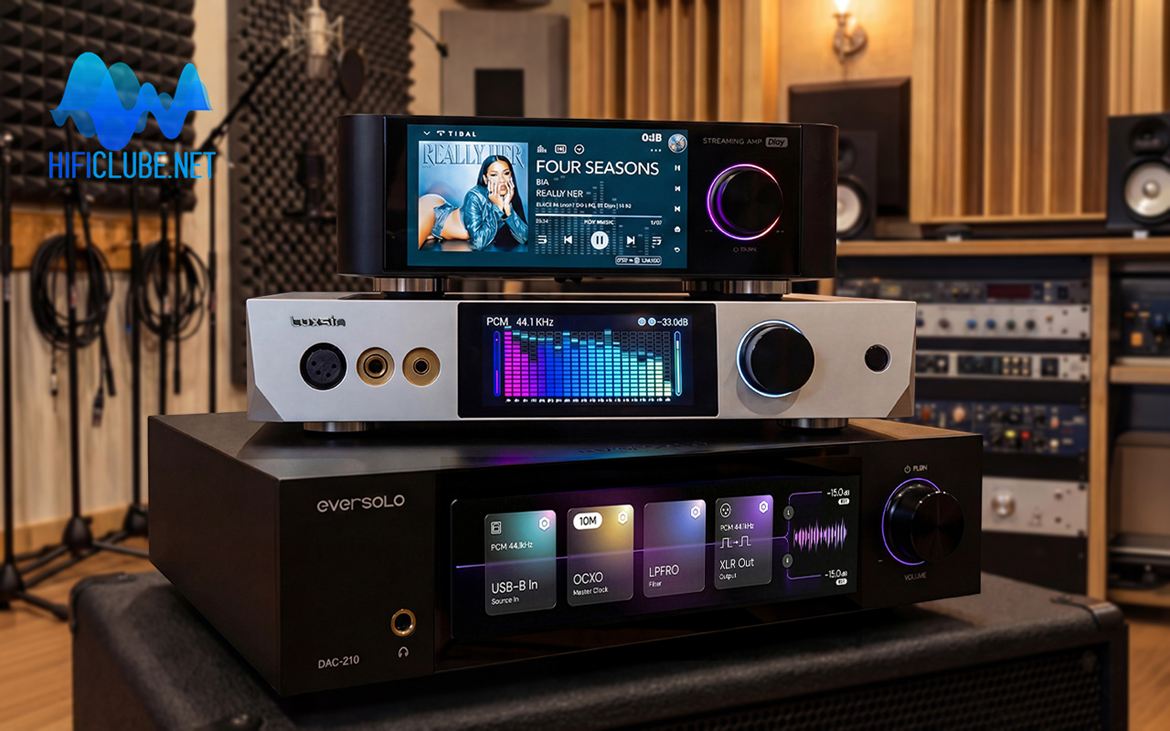
They all come from a happy family in China. From top to bottom: Eversolo Play, Luxsin X9, Eversolo Z-10
From the Luxsin X9 to Eversolo Z-10
Whenever I visited the Eversolo stand at the High-End show, I asked Eki Shaw, the nicest of PRs, when they would release a new DAC/streamer with a headphone output. In 2025, Terry Jiang from sister company Luxsin surprised me with the X 9 DAC/headphone amp, which features automatic impedance detection and gain adjustment — and may have inspired the Z-10.
However, the X9 (see the review here) also offers PEQ functions and balanced headphone outputs (4-pin XLR and Pentaconn), which the Z-10 omits—perhaps because the aim was to achieve purity of sound through a more minimalist approach.
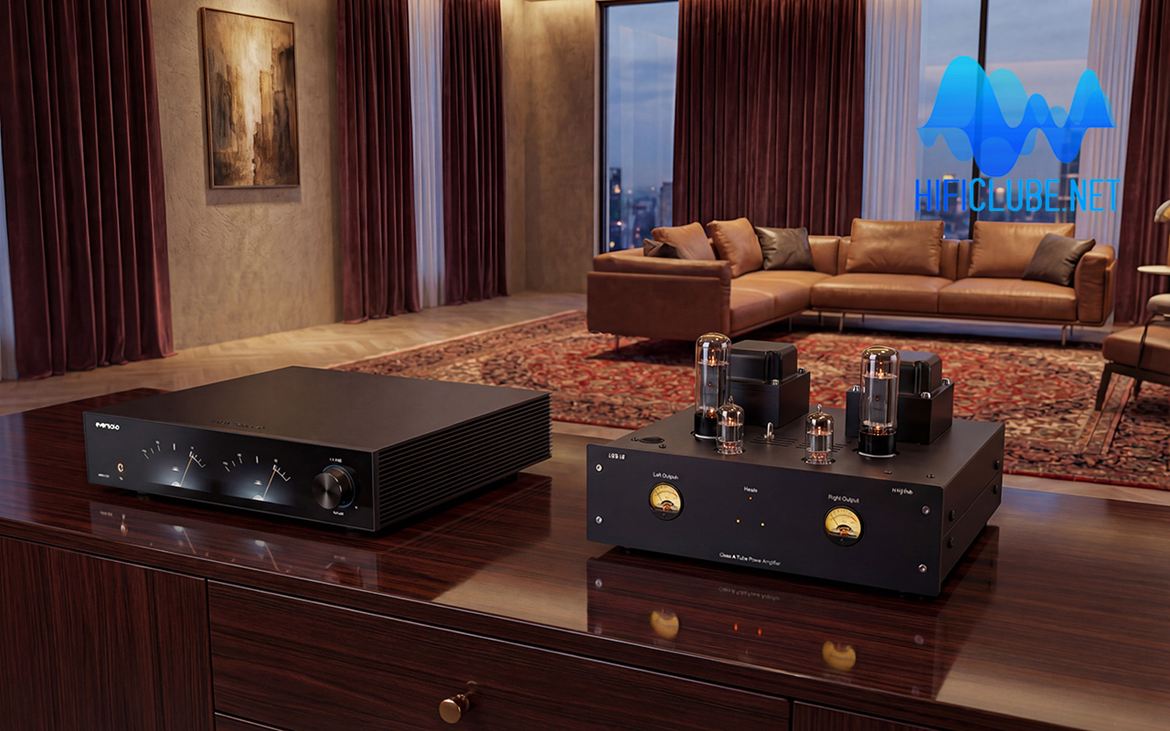
The LAB 12 'Mighty' (in triode mode) brings back some of the flavour and warmth to the Z-10's lab perfection.
Don’t tell a preamplifier by its sound
By definition, a preamplifier has no sound of its own; it should simply let the music pass through without altering it.
Sources have their own character, and loudspeakers even more so, though their “poise” heavily depends on the amplifier, which holds the reins.
In this context, I used only digital sources: the Eversolo Play streamer exclusively and a discontinued universal transport from Oppo, capable of playing all known optical disc formats — CD/SACD, Blu-ray Pure Audio, DVD-Audio, HR-X, etc.
For loudspeakers, I selected only compact monitors: Sonus Faber Concertino, Azzolina Quark, and Acoustic Energy AE 300-2, as they provide greater coherence in near-field listening, and I wanted to assess the Z-10's degree of transparency without the bass getting in the way. A LAB 12 Mighty valve amplifier powered them, and we'll see why later.
Electrical transparency
An audio component with a SINAD of -115 dB or higher is electrically transparent. Electrical transparency means it allows the signal to pass through without adding distortion, noise, or colouration. This describes the Z-10, with a SINAD of -120 dB. However, if I connect it to a Class A valve amplifier with a SINAD of -90 dB (or lower), then some of that transparency will inevitably be lost—although the distortion is mainly second-harmonic and thus benign to the human ear.
So, where does that leave us? Let's move beyond lab-measured transparency and focus on analysing acoustic transparency while listening.
In a truly transparent system, we hear deeper into the music, as if the equipment ceased to exist — and suddenly the whole picture appears: the forest and the trees, with all that implies, including subtle spatial and harmonic information. And yet...
“A dream… ‘is never what one sees when one opens the window’, as Alberto Caeiro puts it.”
Transparency is often confused with clarity. But they are very different concepts. To better convey them, I will resort to the teachings of the late Harry Pearson, founder of TAS, albeit in my own words:

Master Harry Pearson giving a lecture on transparency in audio reproduction.
Harry Pearson on transparency
Transparency is a more comprehensive quality than clarity; it is almost holistic. It is the ability of a system to function as a clean window—an unobstructed portal to the recording (or to the original event)—allowing the listener to “see through” the equipment and reach the complete musical event, with minimal obstacles along the way. And this is not just a matter of more detail or information: it includes the preservation of space (stage depth, air, bloom, or room ambience), the natural timbre and tonal colour of instruments, dynamics, and that precious feeling of an absence of electronic fog.
Clarity, on the other hand, is a narrower notion, focused on resolution and definition: sharpness of detail, separation between instruments and voices, clean extension of the high frequencies, absence of smearing or blurring, and precise articulation. The problem is that, unlike transparency, when overdone, clarity comes at a price: colour, body, and musicality may be lost. That “X-ray” sound emerges — etched — in which detail jumps out yet timbre becomes faded, artificial, almost bleached without flesh and blood… almost lymphatic.
Or, to quote Fernando Pessoa again: “Something of the sea, but not the sea”.

The bronze statue of Fernando Pessoa, in Chiado, Lisbon, with the Z-10 on his coffe table
Virtue and vice
The Z-10, which costs just €1,980, is remarkably transparent — so transparent that it can be unsettling, especially for competitors. Yet some excess of clarity might diminish some of its musicality or, if you prefer, its neutrality. Fortunately, it does not give you an X-ray view, nor does it strip the sound of flesh and blood; yet the colours could have a touch more saturation.
Yes, I know saturation is often nothing but colouration, and the Z-10, at most, suffers from a sin of omission, rather than adding anything to the signal.
Alas, what may feel or sound good can sometimes be sinful and harmful to both our health and the device's specifications or merely indicative of poor engineering. The Z-10's bill of health speaks for itself. So, I dared to pair the Z-10 with a valve amplifier, balancing its virtues of transparency and clarity with a guilty touch of euphonic colouration: 2nd harmonic distortion. Mea culpa!
To illustrate his point, Harry Pearson often used LPs of live, well-recorded classical music as a reference — recordings that preserve a real acoustic event. Today, much of what we hear is created in studios, sometimes with instruments that were never in the room. And now we even have “artists” generated by AI who do not exist at all. So much for transparency… or rather, the Z-10's transparency has never been more revealing of the truth.
Which brings me to my final point as the devil’s advocate.
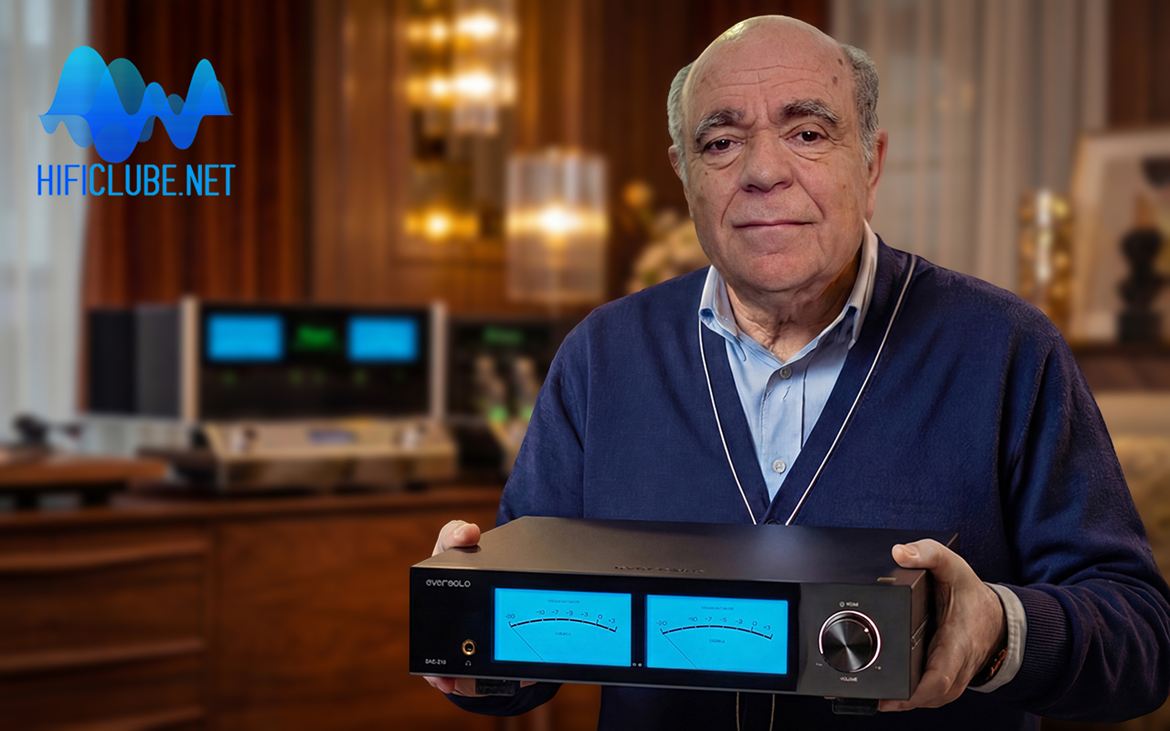
I am JVH and I stand by what I write.
The Eversolo Z-10 DAC/Preamp/Headphone Amp is for those who want to hear exactly what’s on the recording—not what they wish was there. If you want an honest, transparent digital decoder and analogue preamp for under €2,000 (and, frankly, beyond): THIS IS IT!
For further informations, contact: