



The MOON 371 is the first model in Simaudio’s new Compass Collection, but it does not feel like entry-level in an apologetic sense. It points to the North Collection above, from which it inherits the design language, technology, and understated precision characteristic of Canadian high-fidelity audio.
I have seen it described as both a Network Player and a Streaming Amplifier. In fact, it encompasses both concepts and more, as it is also an excellent integrated analog amplifier.
The 371 combines, in a single chassis, an integrated amplifier, a pre-amplifier, a MiND 2 streamer, a DAC, an MM/MC phono input, a highish-impedance headphone output (derived from the internal power amplifier), and a pre-amplifier output. All you need to add are speakers—and, of course, music. And I did just that.
The rated power is 100 W per channel into 8 ohms and 200 W into 4 ohms, figures that independent measurements by some of my distinguished colleagues at EISA have exceeded: 140 W into 8 ohms and 260 W into 4 ohms.
We know that watts are not everything. For example, the 371 is a Class A/B amplifier that stands apart from the competition because, instead of using the classic global feedback model, it employs proprietary technology known as MDCA—MOON Distortion-Cancelling Amplifier—designed to reduce distortion via an exclusive error correction circuit.
Hybrid power
Furthermore, it uses an MHP–MOON Hybrid Power switched-mode power supply. Therefore, it does not use the usual toroidal transformer found in linear power supplies, although it employs comparable filtering solutions.
Hence, its weight of just 9 kg is quite surprising for an amplifier of this power, despite its dimensions of 42.9 x 8.7 x 38.5 cm, which place it in the ‘slimline’ category. Yet one glance is enough to identify it as a ‘MOON’.
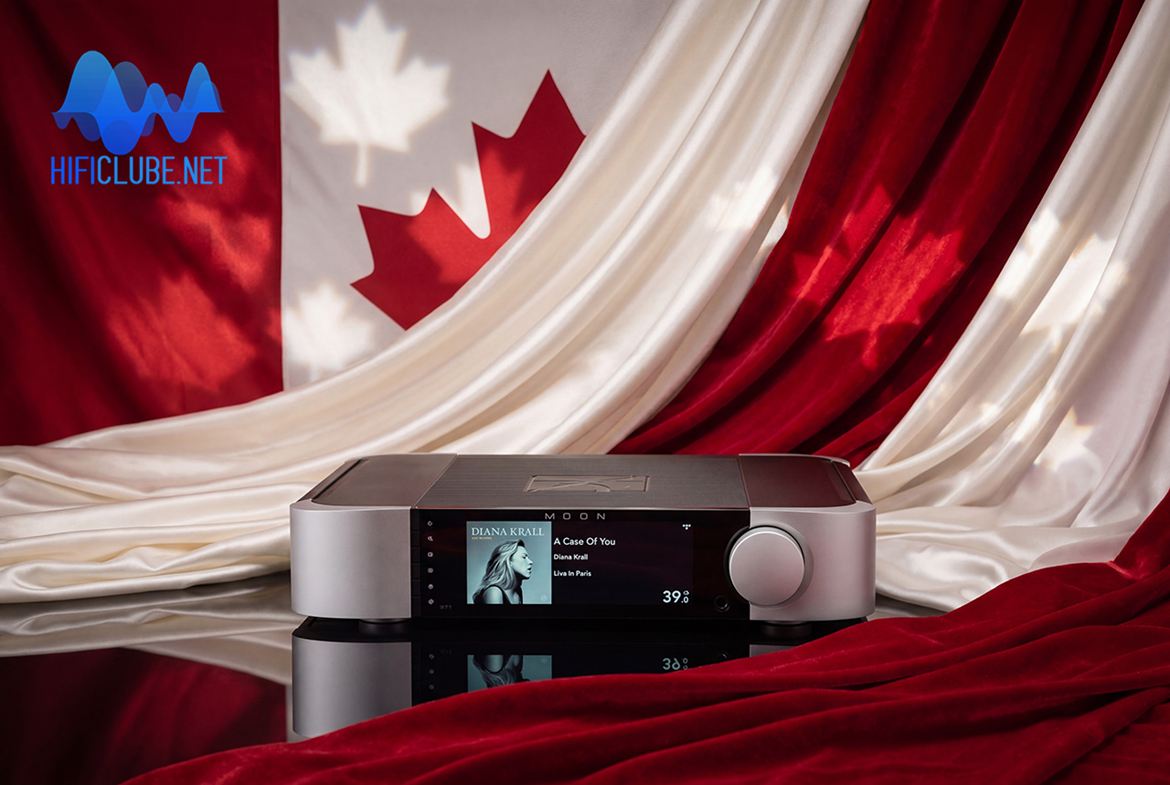
The front panel focuses on functional elegance: a large color display, an aluminum volume knob that adjusts in 1 dB steps from 0 to 30 and in 0.5 dB steps from 30 to 80, combining speed and precision, and a 6.35 mm headphone output.
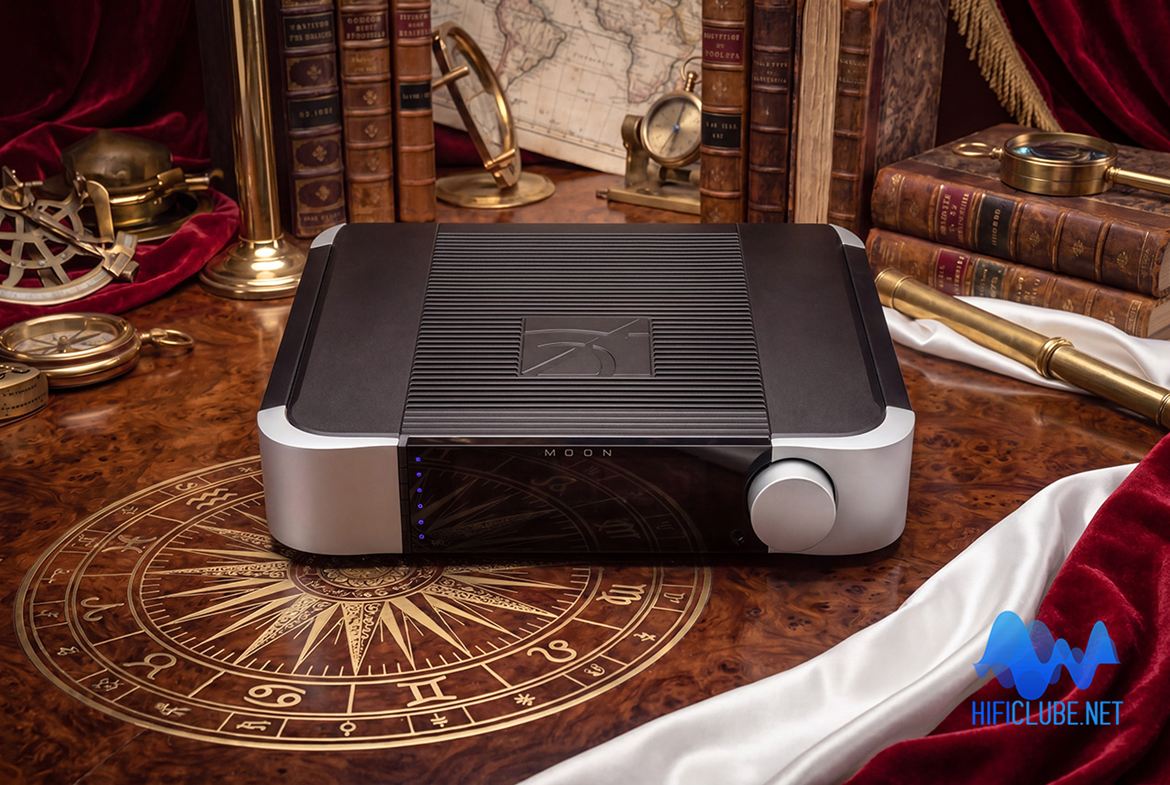
The design is very clean, with rounded edges and free of razor-sharp medieval heatsink fins. No nuts or bolts are visible. Only at the back.
The colour display is not touch-sensitive—which may be misleading at first glance—but it shows the album cover, volume (in large digits), the selected input, and other playback information.
The rear panel, however, is anything but minimalist: it offers one RCA line-level input, one balanced XLR line-level input, an RCA phono input with a ground terminal, a variable RCA pre-amp output, a coaxial S/PDIF input, an optical input, HDMI ARC, two Ethernet ports (!), Wi-Fi, Bluetooth, a USB-C Host port for reading files from external storage, and a USB-C service port.
Note: The 371 lacks a USB-B/USB DAC input for direct connection to a computer, which is a shame. Not everyone has a strong internet signal. The USB-C Host port is therefore suitable only for USB drives or sticks, not for using the MOON as a conventional USB DAC.
Always on my MiND
The MiND 2 app is functional but offers nothing new compared to the existing Tidal Connect and Qobuz Connect apps, and even less compared to Roon, with which it is compatible. I found it a little fussy. You can use a remote control instead for the average functions.
MiND 2 provides access to Qobuz, Tidal, Spotify, Deezer, internet radio, UPnP/DLNA, AirPlay, Bluetooth, Tidal Connect, Qobuz Connect, Spotify Connect, Audirvana and Roon Ready. Network/USB Host playback supports PCM up to 384 kHz and DSD256; the physical digital inputs have their own limits: coaxial up to 192 kHz, optical up to 96 kHz, and HDMI ARC up to 48 kHz.
From digital to analogue
The DAC is based on the ESS ES9039Q2M chipset, with Simaudio’s own implementation, offering a fixed filter type, a low-jitter clock, and a dedicated power supply. My colleague Paul Miller, from Hi-Fi News, measured digital jitter of less than 10 psec at 48 and 96 kHz. This is state-of-the-art, indeed.
The phono stage is compatible with MM and MC cartridges, with fixed gains of 40 dB and 60 dB. The load values are also fixed: 47 kΩ/100 pF for MM and 1 kΩ/0 pF for MC. There are no fine adjustments for impedance, capacitance, or gain, nor is there a rumble filter.
Spinning Doctors
I usually avoid long comments on phono stages for the simple reason that I no longer own a turntable, although vinyl can sometimes sound better than digital, depending on the system used and the LP played.
However, the vinyl revival has always struck me as a partly ‘woke’ cultural scene, sustained as much by modern lifestyle imagery in TV series and on social networks as by sound quality. In most homes, the phone is now the default music source. And the MOON 371 is fully prepared for that reality too.
And the sound?
Control and tonal integrity—which is no surprise, with a damping factor of 425—remind the loudspeakers who is in charge.
As for the much-vaunted audiophile clarity, it presents itself with a delicate, warm, almost valve-like character. The top end does not come across as harsh or grainy, though I think that depends largely on the quality of the speakers’ tweeters.
The soundstage lacks that laser-sharp 'pinpoint' focus some crave, so the sweet spot is wide, and the presentation is broad and deep, with plenty of spatial cues. Do not expect an anatomical dissection of the sound, though; instead, prepare to hear organic coherence.
A Case of You
When I first heard it, at the Hi-Fi Show in Estoril, in the Sound & Pixel room with DALI speakers, the conditions were far from ideal. And yet, even there, amid the inevitable noise, movement, and acoustic compromises of a show, I realized I was in the presence of something truly special.
I remember thinking, Why don’t they play Diana Krall’s ‘A Case of You’ instead so I could listen to Joni Mitchell’s lyrics filtered through that dark Canadian contralto voice, live in Paris, with the piano notes dying away in a quiet confessional mood?
Where one can almost peer into the darkness and see the audience suspended in a collective trance, all eyes and ears focused on Diana Krall under the spotlight, as she turns the song into a close-miked prayer to Canada:
Oh (Canada), you're in my blood like holy wine
Oh, you taste so bitter and so sweet
I could drink a case of you, darling
Still I'd be on my feet
Now that I have listened to the 371 at home, albeit with a pair of small Sonus faber Concertino speakers, I feel the same about the MOON 371 as she feels about Canada. The 371 didn’t just enter my system. It got into my blood — like wine. And still, I was on my feet. Or rather, glued to my chair.
It’s all there:
Diana Krall's presence. Her powerful, husky voice. The sensuous breathing. Her lips almost touching the microphone. The saliva in her mouth. The air inside the venue. Perhaps the hardest thing of all for any audio system to reproduce is silence. That momentary, bustling silence that comes from thousands of people, sitting in the dark in religious awe, anticipating an eruption of applause in the end.
A remarkable machine
It is then that the MOON 371 ceases to be merely a streaming amplifier and becomes something even more remarkable: a machine capable of bringing recorded music to life.
The MOON 371 has a few limitations that Simaudio considered irrelevant in a recent informal Zoom conversation. These include the lack of a USB DAC for a computer (it can connect via Wi-Fi); fixed gains and loads on the phono input (independent measurements show the RIAA curve is perfect); and the absence of DSP and room correction, which many purist audiophiles take with a pinch of salt, anyway.
It is therefore not an amplifier for those who want to fine-tune every digital parameter, correct the room with DSP, or connect directly to a computer via USB. Nor is it a home cinema hub, despite the HDMI ARC. Above all, it is a fine integrated amplifier for demanding audiophiles who want to strip the system down to its essentials without sacrificing modern convenience.
The price in Europe is €6,800. However, this figure becomes almost reasonable when you consider it includes a 100/200 W amplifier, a Roon Ready streamer, a high-quality DAC, a good MM/MC phono pre-amplifier, a headphone output, HDMI ARC, and Canadian manufacturing with a ten-year warranty, which, according to Simaudio, also applies in Europe.
The Compass Collection gets off to a good start. A very good start, indeed. The name is ‘compass’, but the 371 does more than just point north: in many systems, it is already the final destination.
Product: MOON 371 Network Player/Streaming Amplifier
Price: 6,800€
Distributor: Sound & Pixel