


The Nagra Streamer is a transport, not a DAC. Period. The question is simple: can it make a DAC sound …better? JVH finds out.
Nagra Streamer: Introduction by JVH
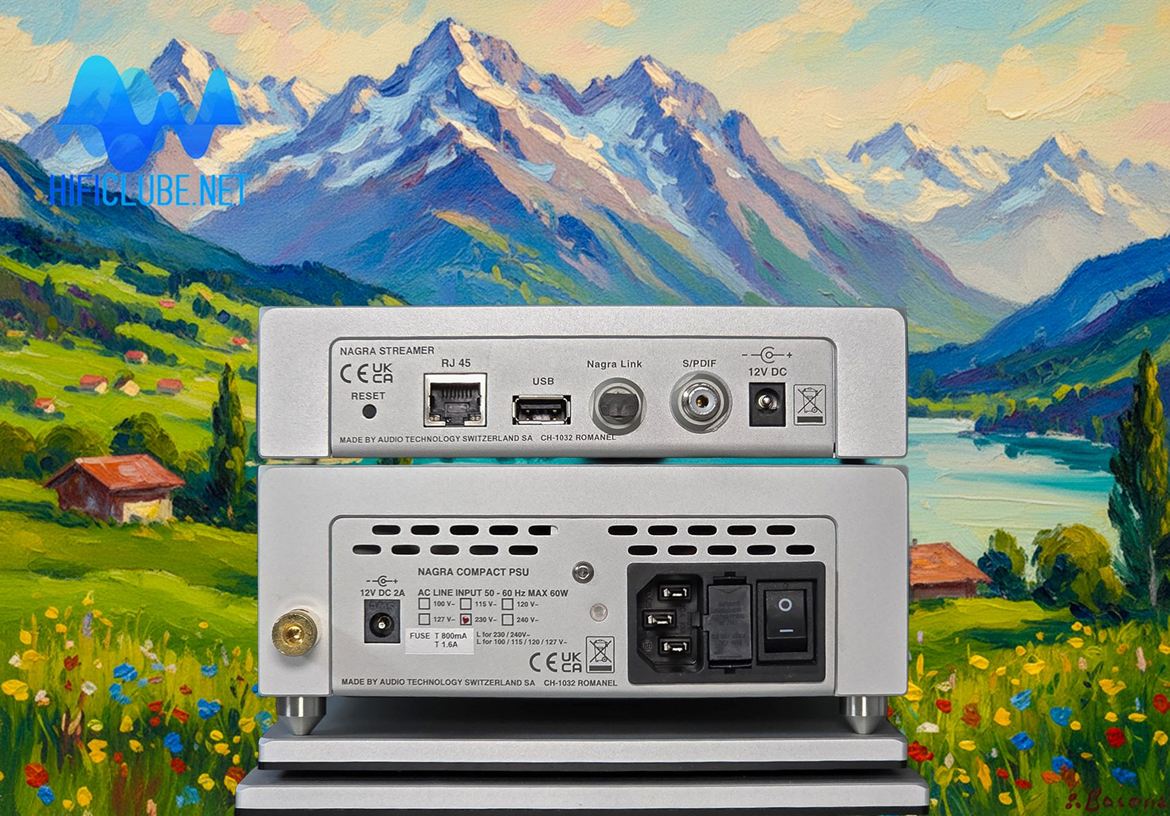
The Nagra Streamer is a pure digital transport or network player (TIDAL and Spotify Connect, Roon, AirPlay 2, UPnP/DLNA, etc.), meaning it does not include a DAC. It receives the music from the network – streaming platforms and files stored on USB sticks or hard drives – and delivers it in full to an external DAC via coaxial cable, supporting a maximum resolution of 24-bit/192 kHz and DSD64.
Those already in the exclusive Nagra club can take advantage of the ecosystem and connect it via N-Link (fibre optic cable included) to a Nagra DAC. In addition to galvanic isolation, this provides access to 384 kHz PCM and DSD 256 resolution with the Nagra Tube DAC, HD DAC/X, Reference DAC, and Classic II DAC. All are (very) expensive toys.
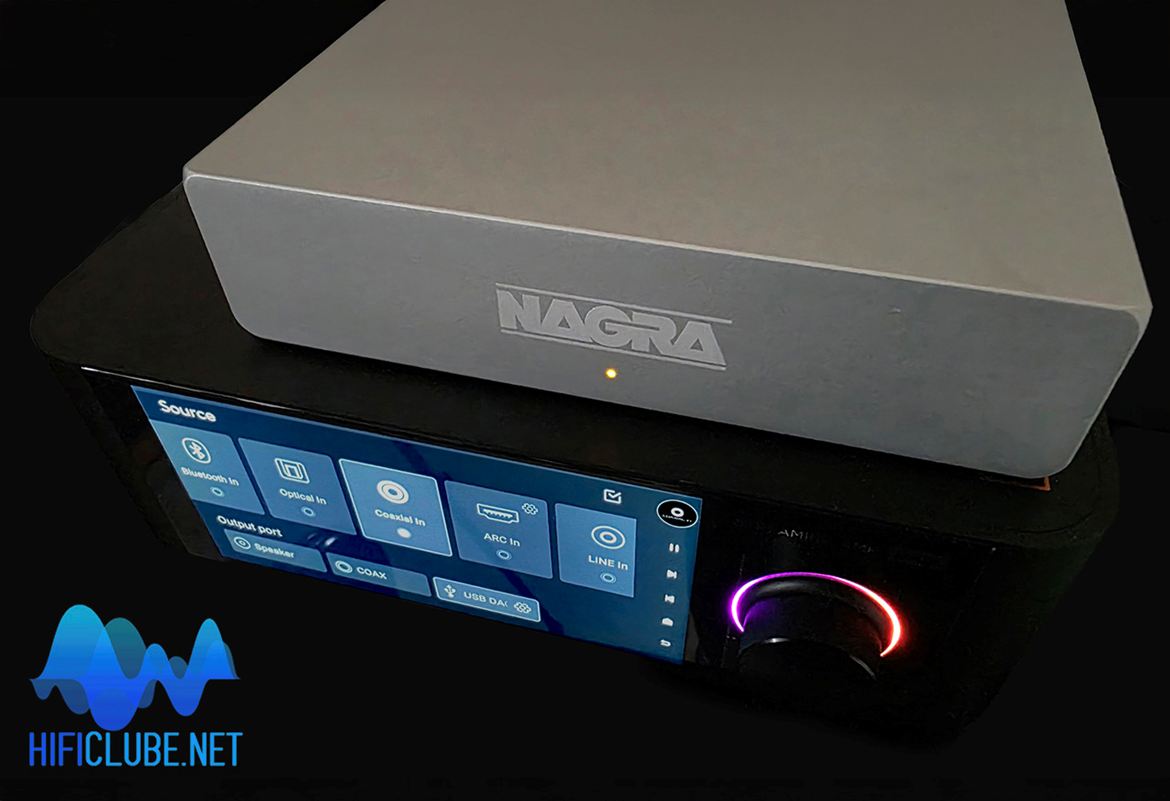
AJASOM sells this solid aluminium little square box, measuring 18.5 × 16.6 × 4.1 cm and weighing 1.9 kg, with no buttons or display – just a simple LED – and no dedicated app (it works with mConnect) for €4,990 (which is modest by Nagra standards, mind you!). Add another €3,780 for the Compact PSU. There is also a VFS isolation platform or base (€1,470). But we will get to that later.
Full signal delivery
In Nagra's defence, I could write a tirade about the prestige of this Swiss brand, which has been on the market for over 70 years, or about the quality of its construction and electronic components.
However, the main justification for the price lies, and I repeat, in the “full delivery of musical content” to the DAC. No matter how good a DAC is or the components in the rest of the chain – preamp, amplifier, and speakers (not to mention the cables)—if the source does not fulfil its duty “in full”, nothing can save the music afterwards.
Now, the Nagra Streamer, being a compact and portable model (with its original PSU), still manages to preserve the digital signal, and that comes at a cost.
But Nagra customers do not look at the price; they look at the quality.
Of course, you also have the option of buying less expensive Asian streamers from AJASOM, which work very well, such as HiFi Rose.
Fortunately, as an audio critic, I had the privilege of living with the Nagra Streamer in my home for some time, as if it were my own. It will only cost me personally when I have to return it to AJASOM.
Plug & Play
I love testing these “Plug & Play” products, which do not require a master's degree to learn how to use all the features and do not force me to spend more time reading the manual than listening to music.
Just connect the Nagra to your home network via Ethernet and to the DAC via coaxial cable. That is it. But have a mobile phone handy (who does not?), as you will need it.
We have already seen that the Nagra Streamer does not have its own app. But you can install the mConnect Control app which is free. It is also compatible with Tidal, Spotify e Qobuz Connect and is Roon and Audirvana ready, if you have them installed on your computer, always via Ethernet.
Chinese versatility vs Swiss exclusivity
Do streamers have a sound?
What about sound quality? By definition, streamers are bit-perfect and do not have their own sound quality, as it largely depends on the DAC we use. To be properly appreciated, the Nagra Streamer should be paired with a DAC from the same brand, connected via an N-Link optical cable, which I did not have.
Instead, I connected the Nagra Streamer to the Eversolo Z10's Coaxial 1 input, alternating with the streamer section of an Eversolo Play, also connected to the Z10's Coaxial 2 input.
The Z10 thus functioned as a standard DAC, a preamp for the LAB12 Mighty single-ended tube amplifier (which powered a pair of Azzolina Quark speakers), and as an amplifier for a pair of Hifiman HE1000 high-resolution planar magnetic headphones.
To compare the two streamers (streaming from Tidal Connect), I simply switched between coaxial inputs 1 and 2 on the Z10 after first equalising the volume with a 1 kHz tone.
Note: On the Eversolo Play, the volume was set to MAX, and all DSP/EQ/room calibration settings were set to OFF, serving only as a streamer.
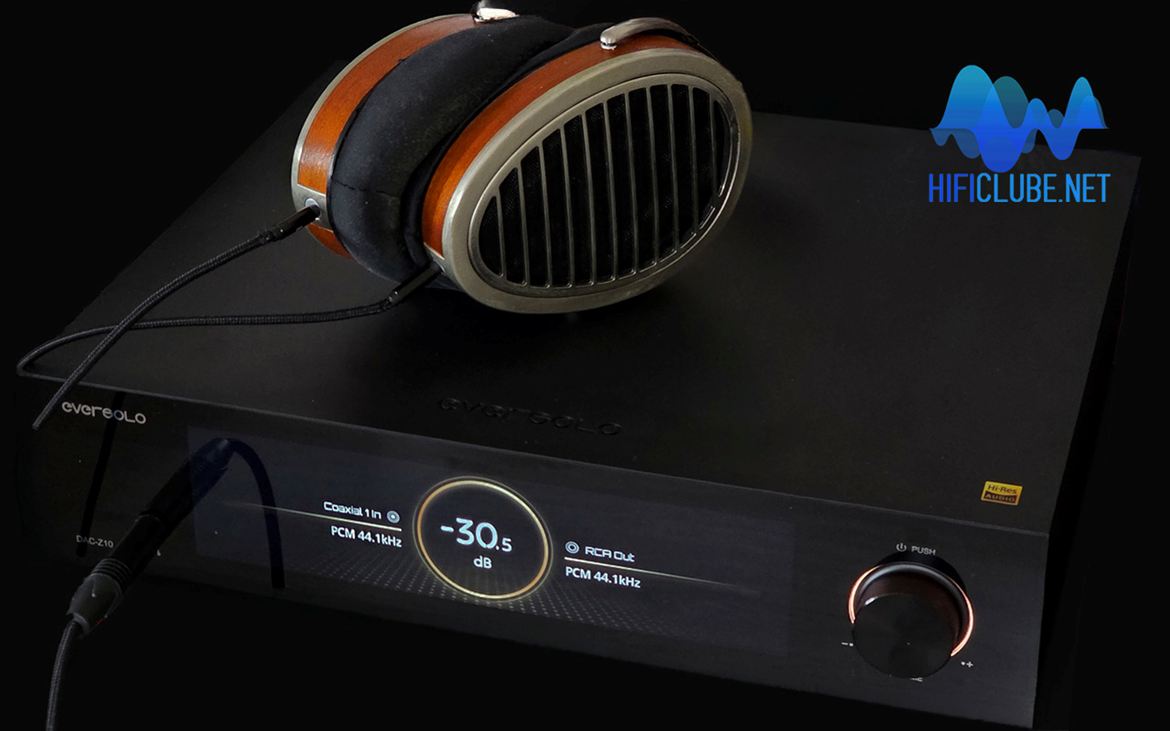
Eversolo Z10 DAC
Perceived value
Can you hear more music from the Nagra than from the Eversolo Play's internal streamer when both are connected to the same DAC via a coaxial cable? No. Does the music sound better? Probably, yes. Call it 'transparency' if you need a single word to define what sets them apart.
The first impression is that the Nagra's background noise is less opaque, and the notes sound cleaner, with more natural contours and polished edges.
The difference is more obvious with the Compact PSU connected, but it will be even more evident with a better-sounding system, reaching audiophile heights with a Nagra DAC and N-Link connection. Lucky are those who can afford a complete Nagra system. But you can also listen to it for free at AJASOM.
Intrinsically correct
The sense that there is something “intrinsically correct” about the way the digital signal is delivered to the DAC – and that this makes even free Spotify sound acceptable – is a feeling I usually only experience with ultra-high-end products, such as the dCS Varèse system and the Antipodes Oladra streamer, especially when I powered the Nagra with the Compact PSU, which raises the price to €9,000 yet is still far from the tens or even hundreds of thousands that the aforementioned models cost.
AJASOM offers another Swiss streamer, the Wattson Madison LE, which also has this “organic” quality and, for the same price (€4,995), includes a preamp and DAC. It is, therefore, an alternative worth considering.
Listening and knowing how to listen
When trying to justify a price difference – sometimes an obscene one – the usual tactic is to claim “it has more detail.” But every promotional brochure promises that. The reader must therefore be guided to listen for specific things – and to understand why they now hear what they did not hear before.
What separates something good (and expensive) from something less good (and cheaper) is microdynamics (subtle variations in intensity) and temporal coherence (the organic flow of music), and also the attack (how the note begins), the sustain or decay (the note's duration), and the release (how the note ends: harmoniously or abruptly). Finally, there is the air or space between notes.
But none of this is easy to identify in a blind test. The listening conditions and the listener's state of mind are key factors. It's not enough to just hear; you have to know how to listen.
Nagra's background noise is less opaque, and the notes sound cleaner, with more natural contours and polished edges.
The sibilant truth
The reproduction of consonants, especially sibilant sounds – “s” and “sh” – and fricatives – “f” – offers a more accessible approach.
These are often “wrapped” in intermodulation distortion, which the human ear struggles to identify as distortion and instead interprets as a phonetic event unrelated to the musical sound.
Sibilants occupy a part of the spectrum where the ear is highly sensitive, and it is easy to mistake clarity for transparency, making the articulation of a sibilant seem separate from the word, rather than a natural part of it.
Those who articulate words also produce the sounds of cymbals and brass instruments, which acquire a high-frequency “spray” unrelated to the fundamental note. The brain tries to integrate these harmonics as natural, but they never quite “fit,” resulting in listening fatigue.
The devil is in the details
This is why many people confuse resolution with excessive detail. When there is distortion – or, more subtly, graininess and intermodulation – the sibilants reveal everything: the “s” stops being a consonant and becomes a spurious effect alien to the word. Instead of being smooth, sensual, and integrated, the “s” becomes ‘spitty’, “projected” and may even sound louder than the word itself.
Of course, I am exaggerating to clarify my point, because in reality, the differences between streamers are not that obvious. However, they do exist. Hence the price differences.
Compact PSU – VFS
In the comparative listening tests, I used the Nagra Streamer with the Compact PSU mounted on the VFS platform.
The VFS is a decoupling base designed for the compact line. It may seem like a “luxury” accessory, but the underlying principle is solid: by reducing the effects of vibrations (from the room, furniture, nearby transformers, or the equipment itself) in a circuit that relies on stability, it enhances sound quality.
The Compact PSU does three things that the listener immediately notices when listening to music:
- Increases contrast
There is more “black” between notes – not a sterile void, but a fertile silence that enhances the contours of the instruments.
- Increases temporal stability
The sound makes more sense in time and space.
- The bass gains intentionality
The bass becomes tighter and better defined. It is not necessarily deeper – it is more informative. The note starts, develops, and ends with greater clarity, which enhances rhythm without inducing “weight”.
Tracks for listening tests
Here are some examples with tracks that everyone knows, so you can conduct your own listening exercises.
- Norah Jones – “Don’t Know Why” (Come Away With Me)
This track is a simple test: if the voice sounds human, everything else tends to fall into place.
What to listen for: the consonants (“s,” “sh”), the air around the voice and the piano (harmonics), the brushes on the snare drum, and the double bass.
Nagra vs Play: with Nagra, Norah Jones seems to have less body and more presence; the consonants sound more crisp, but without aggressiveness; the brushes “sweep” without harshness, and the double bass marks the constant, languid rhythm. With Play, everything sounds the same, only more polished and also more “processed”, perhaps less organic.
- Leonard Cohen – “You Want It Darker”
It’s not the extension that matters, but rather density and texture.
What to listen for: the roughness of the voice, full of drama; the choir in the background; and the sense of space. The air that hangs and then “settles” on the studio floor.
Nagra vs Play: Nagra manages to give the voice density without “thickening” it too much – Cohen has “gravitas”, but no artificial weight. Above all, it better separates the voice and the choir, thereby gaining credibility and verisimilitude.
- Keith Jarrett – “The Köln Concert, Part I”
Solo piano is unforgiving for sound systems. If there is grain, you can hear it. If there is jitter, you can hear it too. Ditto if the piano is out of tune (and Jarrett's piano was out of tune, but even that he overcame graciously...).
What to listen for: the hammer (attack) and the harmonics that follow, like soap bubbles hovering in the air until they die in the darkness of the room; and the pedal (the connection between notes).
Nagra vs Play: with Nagra, there is more continuity in the notes: attack, body, and tail, without interruptions. With Play, the attack seems equally fast, but the note dies sooner.
- Martha Argerich (Chopin) – Polonaise
Argerich is speed, contrast, and control.
What to listen for: lightning-fast attacks and microdynamic variations (the intentionality behind the virtuosity).
Nagra vs Play: Nagra tends to sound cleaner without hardening; the transients' edges are polished but keep attack power. The fortissimos do not lose their composure or retreat. Play has more body but less “substance”.
- Dave Brubeck – “Take Five” (Time Out)
We have heard this a thousand times, but with the right system, the track takes on a life of its own.
What to listen for: the saxophone and piano, of course, but above all, the way the drums set the tempo without forcing the note.
Nagra vs Play: on the Nagra, the rhythm seems more settled, with the swing coming naturally, even when attention is focused on the drummer's work. With the Play, the music is the same, of course, but the swing is less fluid.
- Massive Attack – “Angel” (Mezzanine)
What to listen for: the sustain of the bass and the layered construction of the track; the muted voice is blown in contrast to the deeper voice.
Nagra vs. Play: the difference isn't great. The Nagra seems to have more control over the bass, leaving the field clear for the voices and electronic percussion. There is less compression, and the mix is more legible. But it is definitely not my cup of tea.
Final words
Audio critics are like political analysts: when they get it right, they look like geniuses; when they get it wrong, they say “the context has changed” – and in the end, it is always the voter... or the listener who decides. Happy listening.