


Leitor artigo em português aqui
I still remember my first NAD. With their olive-green military-style look those early NADs were true audio commandos: Few watts, plenty of firepower. In fact, it was with an NAD that I got my start as an audio critic, in an article titled: Som DaNADo!, a pun in Portuguese that means 'Damn Good Sound'.
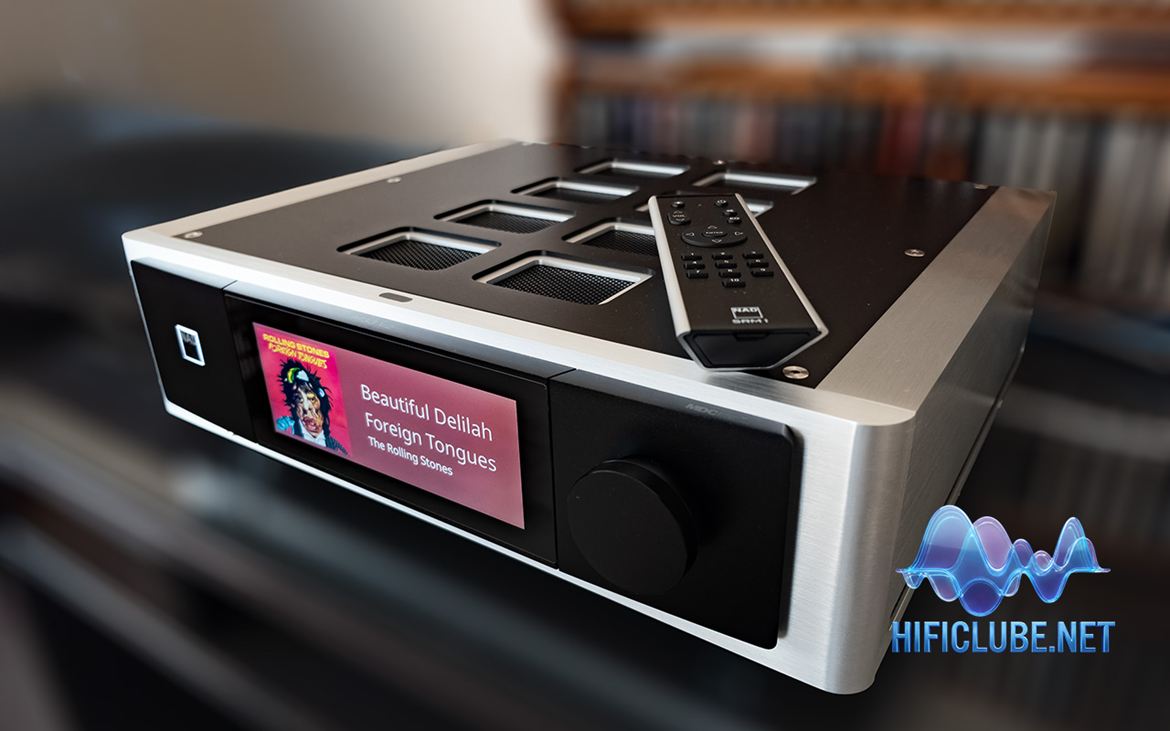
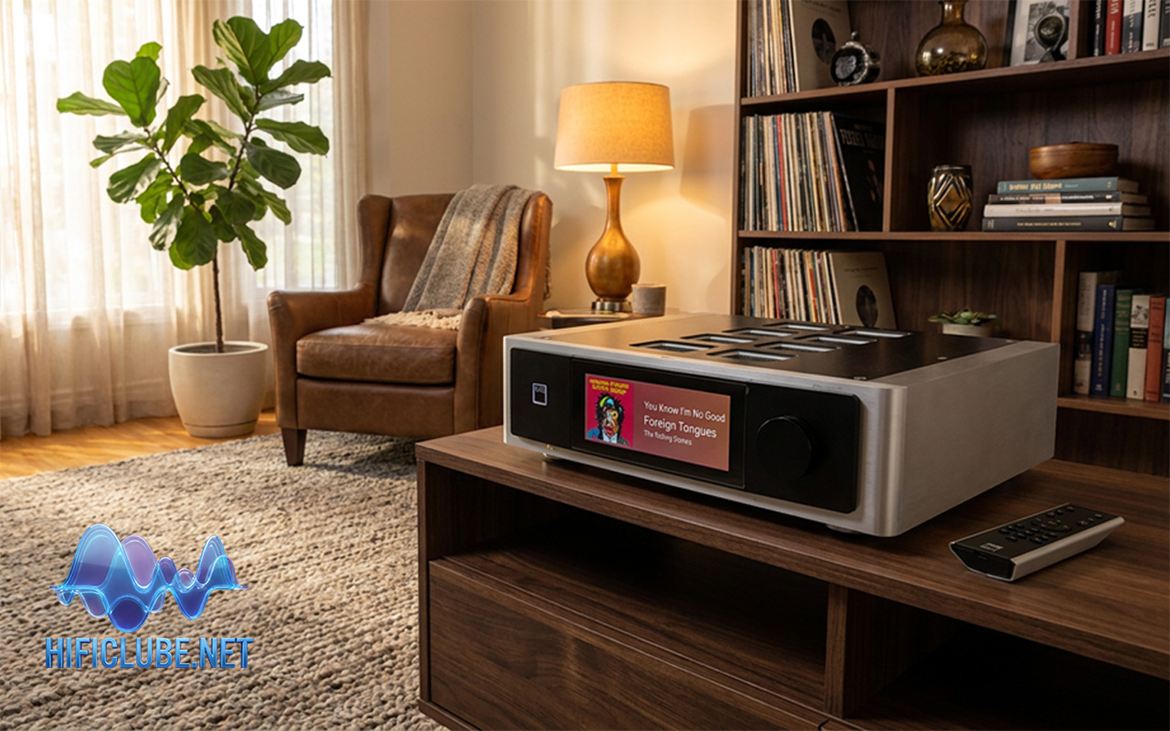
The NAD Master Series has maintained this philosophy of efficiency and pragmatism. But the M33 V2 is now a luxury product, featuring a sturdy machined aluminium chassis with a vented top panel, a large volume knob, and a seven-inch colour touchscreen that gives you direct access to all functions.
Note: The volume knob is a mechanical marvel that rotates smoothly and operates at 32 bits in the digital domain.
In a single chassis, NAD offers everything required of a modern system: integrated amplifier, preamplifier, DAC, streamer, MM/MC phono preamp, headphone amplifier, HDMI eARC connection, and Dirac Live room correction. The price, of course, bears no resemblance to what NAD had us accustomed to back in the day: 6,699 euros!
True to Its Roots
The V2 is an evolution of the original M33. On the outside, it’s basically the same. Measuring 435 mm wide, 133 mm tall, and 396 mm deep, the M33 V2 occupies the space of a standard hi-fi component.
It weighs just 9.7 kg, which may disappoint those who still judge amplifiers by their weight. The explanation lies in the Class D amplification and switch-mode power supply, which eliminates the need for a huge toroidal transformer—not in any attempt by NAD to save on building quality.
Even the quality of the connectors shows that the luxury isn’t just cosmetic, although the trapezoidal remote control is more robust than functional, often forcing me to go back to the screen or the BluOS app. The app lets you select sources, create presets, manage zones, search for music on various services, and control the M33 V2’s settings. The remote control has only basic functions.
BluOS, in fact, remains one of the M33 V2’s main selling points. It supports network audio with services like Qobuz, Tidal, Spotify, Amazon Music, and Deezer, as well as Internet radio, AirPlay 2, Roon, and BluOS multiroom systems. BluOS does not include UPnP, though, so it is not compatible with one of my favourite apps, mConnect. It also does not support JRiver or Audirvana, as it lacks a USB connection to a PC. However, the M33 V2 is accessible over the network via Roon and can be configured as an MQA decoder/renderer with a maximum PCM resolution of 24-bit/192 kHz.
I must be one of the few who still think Tidal sounds better than Qobuz; for that reason, I used mostly Tidal, Tidal Connect or Tidal via Roon as a source.
Note: M33 V2 is not compatible with DSD files. You have to convert them to FLAC first.
Modular Design
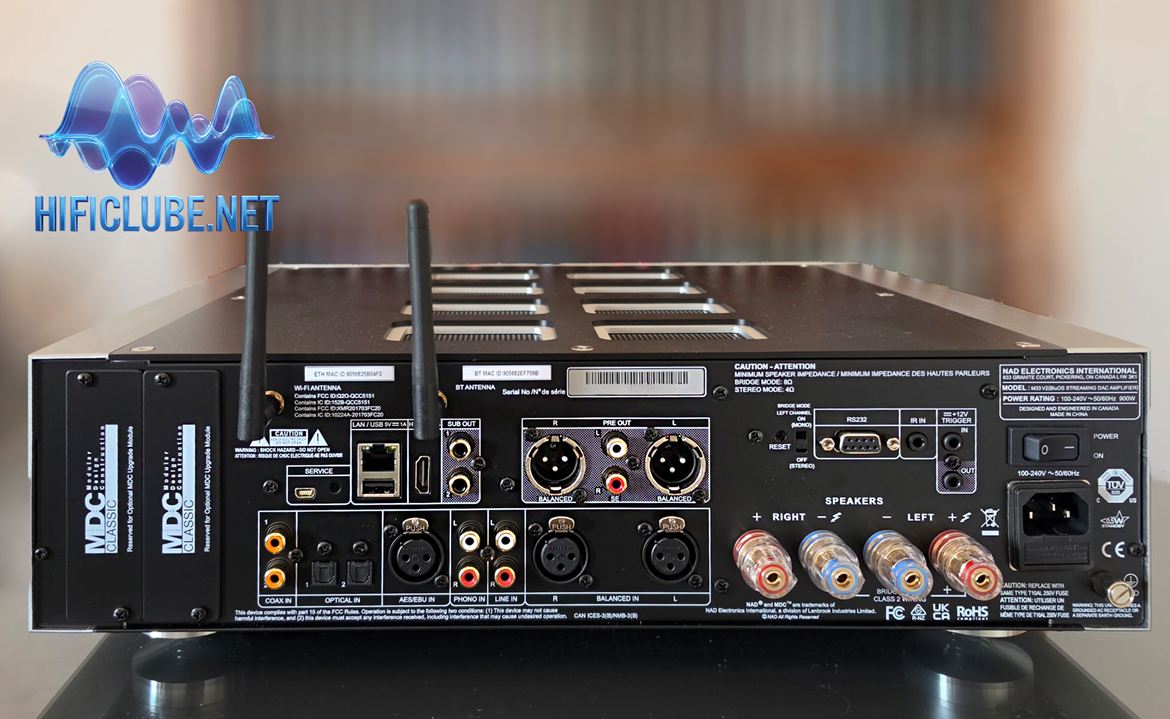
In the analogue section, it offers only one RCA input and one balanced XLR input, in addition to the phono inputs. The digital section is more generous: two coaxial inputs, two optical inputs, one AES/EBU input, HDMI eARC, Ethernet, Wi-Fi, and a USB-A port for compatible storage devices and peripherals.
There are also XLR/RCA preamp outputs, two independent subwoofer outputs, a headphone output, and bidirectional aptX HD Bluetooth, which can both receive music and stream it to wireless headphones. Plus, there are two MDC (Modular Design Construction) slots for future expansions. Alexa and Siri were also invited to the party, but I didn’t talk to them.
Note: The M33 V2 does not have built-in microphones and does not respond to voice commands on its own. However, it can be controlled by voice through compatible external devices: Amazon Echo for Alexa, or an iPhone, iPad, or HomePod for Siri. Integration with Siri is handled by AirPlay 2 and the Apple app; integration with Alexa uses BluOS Voice Control (Blue Voice), which is officially available only in English.
MQA Reborn
For amplification, NAD has adopted custom-built second-generation Eigentakt modules, a new ESS Sabre ES9039PRO DAC, an equally updated ADC section, and FOQUS and QRONO technologies developed by MQA Labs.
Yes, I know. Some people shiver at the acronym "MQA". However, I, Peter McGrath of Wilson Audio, and Robert Harley of TAS still believe there’s more to MQA than just compressed and lossy signals—something to do with temporal precision. But this is like politics and social media: once you fall from grace, it takes a long time—if ever—to get back up.
Fear not. NAD does not use the old MQA technology, and FOQUS and QRONO are not MQA under a new name. These are processing technologies applied, respectively, to analogue-to-digital and digital-to-analogue conversion.
FOQUS operates during the digitisation of analogue sources, with the aim of reducing timing errors and filter-related conversion artefacts; QRONO optimises transient response during PCM-to-analogue conversion by acting on the DAC’s filters and noise-shaping, with the stated goal of reducing so-called ringing in impulse-response tests.
At the very least, it eliminates pre-ringing, which NAD considers more harmful than post-ringing. In fact, any Minimum Phase Slow filter produces exactly the same effect. And it’s not possible to choose different filters, such as Linear Phase Fast filters, which are available on most modern DACs.
However, this is an academic discussion. For the reader, what matters is that, with this digital architecture, all analogue sources are converted to digital before being processed. This happens both at the line inputs and at the signal coming from the turntable. The M33 V2’s phono input accepts MM and MC cartridges, includes an infrasonic filter, and features a specified RIAA accuracy of ±0.2 dB between 20 Hz and 20 kHz.
A Powerhouse
According to the spec sheet, the M33 V2 delivers over 200 W per channel at 8 ohms and 380 W at 4 ohms with both channels driven. Dynamic power reaches 560 W at 4 ohms, though it does not feel like that brute force when listening. The rated peak current is 25 A or higher, and the damping factor exceeds 800 (!). Was it you who asked for a tight, articulate bass?
Harmonic distortion remains below 0.003% from 1 to 200 W. It’s also possible to bridge it, using each amplifier as a monoblock to achieve up to 700 W per channel at 8 ohms, driving big speakers in large rooms.
The Purity of Purifi
The Purifi Eigentakt modules, designed by the Bruno Putzeys' genius, are currently the world record holders in laboratory measurements. No other amplifier, of any class or topology, can beat them. This means that on paper the M33 V2 is completely transparent. In other words, it simply amplifies the signal without introducing any colouration. If you don’t like what you hear, blame the source, the speakers, or, most likely, the room. But NAD has even addressed this by including Dirac processing in the M33 V2’s already extensive feature offer.
If you don’t like what you hear, blame the source, the speakers, or, most likely, the room.
Listening Notes
Just as we miss the sound of “wood” in open-baffle designs, panel speakers or speakers with aluminium cabinets, we also notice the absence of “distortion” or “colouration” in amplifiers such as the NAD M33 V2, whose noise and distortion figures push Audio Precision analysers close to the limits of their resolution.
Perhaps because, over the course of our lives, we were led by audio gurus to accept the second-harmonic distortion of vacuum tubes as beneficial to our hearing. It’s almost like a religious belief, one that science denies. Yet, I am one of those believers. Mea culpa.
So, when I connected the M33 V2 to a pair of Sf Concertino speakers—which I’ve known for 30 years—I found the sound somewhat bland, despite the rated 200 W. By "bland", I don’t mean “thin” or weak, because the bass is all there, taut and extended within the natural limits of a two-way standmount.
However, when I connected the M33 V2’s preamp output to the LAB12 Mighty—which is only 10 W—the sound gained the harmonic body (distortion?) I’m used to. On the other hand, it lost the power and dynamics of Class D. You can’t have it all.
However, the reviewer’s personal taste has no place here. The analysis must be conducted objectively and without audiophile biases. For a month, I listened to the M33 V2 (without Dirac) with all musical genres, mainly via streaming and CD. The M33 V2’s greatest virtue—and perhaps its only “fault”—is its almost disarming honesty.
Full immunity
The M33 V2 seems immune to audiophile prejudices. It’s surprisingly smooth (perhaps due to the digital filter’s early roll-off), dispelling the misconception that Class D is aggressive and unmusical. Even when pushed hard, the M33 V2 always responded with diplomacy, and then only with the necessary force, or proportional force, as they say in military parlance.
The M33 V2’s greatest virtue—and perhaps its only “fault”—is its almost disarming honesty.

Rolling Stones Live on Stage
So, instead of opening fire with the customary selection of Baroque music — which is easy on the ears — and then continuing with an eclectic list of 10 rare albums just to show off my playlist, I chose to put the M33 V2 through its paces with just one band from my era: the Rolling Stones, on their latest album, Foreign Tongues.
Hackney Diamonds was nothing more than a “proof of life" when compared to Foreign Tongues. The Stones had a blast for a month at Metropolis Studios in London, in the illustrious yet discreet company of Paul McCartney (who played bass on Covered In You) and Steve Winwood (keyboards), drawing on a vast palette of rhythms: from funk to country.
In the ballad Ringing Hollow —the album’s best track—they even ventured into political commentary, revealing their current disillusionment with the U.S., which gave them everything in the past (the blues, for example), and even questioning America’s remaining moral authority and denouncing its authoritarian and imperialist tendencies. After all, Trump-bashing sells, while investing on Wall Street pays off.
And Jagger even indulges in a theatrical performance of Amy Winehouse’s confessional song: You Know I’m No Good. Amy must have turned in her grave.
But why am I referring here only to Foreign Tongues when I’ve listened to dozens of albums for this review? Because it answers all your questions. Curious?
The Stones Under the Microscope
The M33 V2 didn’t turn the Stones into a chamber music quartet. But it allowed me to hear a band that was different from the usual one — or rather, it allowed me to perceive more clearly what had always been there in the first place.
The voices no longer form an indistinct choral mass, and—believe it or not—it’s almost possible to make out everything Jagger sings, easily distinguish Mick Jagger’s and Keith Richards’ voices, follow the harmonies, identify the vocal overdubs, and recognise each voice’s entry by its texture, its placement in space, and even by the way each syllable is articulated. Even Jagger’s falsetto in Jealous Lover sounds good.
In Some of Us, Keith’s weary voice doesn’t just sound hoarser: it emerges physically with a different breath, a different weight, and a different relationship with the microphone. And with life.
McCartney on bass
The same is true of the bass lines. In Never Wanna Lose You, Darryl Jones weaves a fluid, muscular rhythm line; in Covered in You, Paul McCartney plays a deliberately simple, fast and incisive bass line.
On first listen, Andrew Watt’s production (Watt also contributes backing vocals) makes the two basses sound remarkably similar at first. The M33 V2 allowed me to hear that timbral similarity, but also what sets them apart: Jones supports and follows the rhythm section; McCartney seems to push it forward, with a drier attack and an almost punk articulation.
And then there’s Hit Me in the Head, still featuring Charlie Watts on drums, shortly before his death. The difference compared to Steve Jordan lies not only in the power of the impact but also in their sense of timing. Watts controls the rhythm with metronomic precision. Jordan is much bolder and more muscular.
The 200 W per channel of the second-generation Eigentakt amplification isn’t just for playing louder. It gives the M33 V2 the ability to reproduce the explosive lift of the choruses, the impact of the kick drum and the violence of the riffs without compressing the soundstage and with only a slight hardening of the treble that can be corrected with EQ.
The M33 V2 doesn’t tame the Rolling Stones. It simply turns on the light in the studio—and lets us peek in to see who’s playing what. And how. I think I'm getting used to this clarity in the sound. It’s like a cleansing of my audiophile sins.
Try this exercise with the albums you love most. You’ll discover things you didn’t know were there.